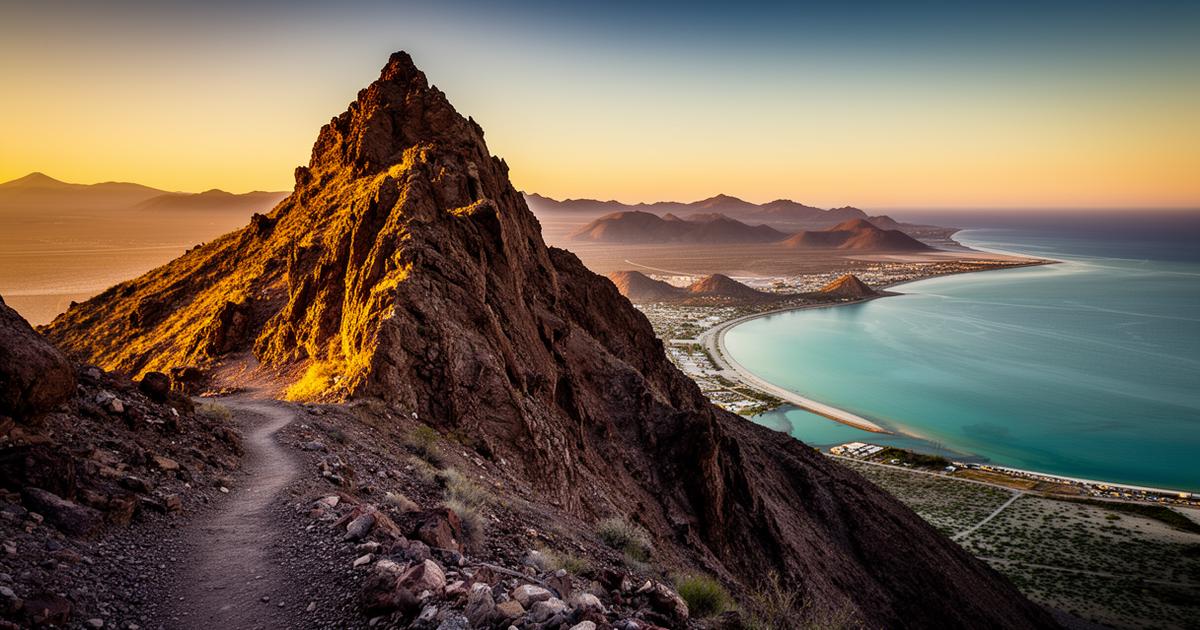
Cerro Tetakawi is the twin-peaked volcanic formation that defines the San Carlos skyline and appears in every photograph of the bay. It is visible from the marina, from the beaches, from the road in from Hermosillo — the landmark that tells you where you are. At 200 meters above sea level, it is not technically impressive as a mountain. As a hike with a view, it is one of the best in northwest Mexico.
The summit looks out over the entire Bahía de San Carlos, the Sea of Cortez beyond, the marina below, the desert meeting the water in every direction. On a clear morning — and mornings in San Carlos are almost always clear — you can see Isla San Pedro Nolasco floating on the horizon.
How hard is the Cerro Tetakawi hike?
Cerro Tetakawi is a moderate 1.5-mile out-and-back hike with about 650 feet of elevation gain. Most fit hikers complete it in 1.5–2 hours round-trip. The first 30 minutes is easy switchbacks. The final 20 minutes involves Class 2 scrambling on loose volcanic rock — not technical, but you need both hands and grippy shoes. Not recommended for kids under 10 or anyone with knee issues.
First time in San Carlos? Explore the full guide to beaches, restaurants, and activities: San Carlos complete guide.
Trail Information
The main trailhead is accessible from the residential area of San Carlos — ask locally for directions to "el sendero del Tetakawi" since the access point is not prominently marked. The trail is approximately 1.5 km each way with 200 meters of elevation gain. That elevation is concentrated in sections — parts of the trail are steep enough to require using hands for balance.
Total time: 1.5 to 2 hours for the round trip including time at the summit. Fit hikers do the ascent in 35–40 minutes. A relaxed pace takes 50–60 minutes. The descent is always faster. Surface: a mix of packed dirt, loose volcanic rock, and sections where you are scrambling over boulders. Not technical climbing, but not a casual stroll. Closed-toe shoes with ankle support are the minimum.
Best Time to Go
Sunrise (6–7 AM) — Best Overall
The trail in the dark with a headlamp to reach the summit for first light. The desert is cool, the city is quiet, and the light hitting the Sea of Cortez at sunrise is something that requires no filters. This is how Mr. Playas does it.
Morning (7–10 AM) — Recommended
Cool temperatures, good light, and you are down before the sun gets serious. The most practical option for most visitors.
Sunset (4–5 PM) — Spectacular but Busy
The most popular time. The light is extraordinary — golden hour over the Sea of Cortez. Get to the summit 20 minutes before sunset to secure a good position. Bring a headlamp for the descent in the dark.
Avoid — Midday in Summer
Rock surface temperatures above 120°F, no shade, and no mercy. The trail in summer midday is genuinely dangerous. If visiting July through September, go before 8 AM or after 5 PM only.
What to Bring
- Water: minimum 1 liter per person. More in summer or if going slowly.
- Closed-toe shoes with grip. Do not attempt in sandals or flip-flops.
- Sunscreen and hat for any morning or afternoon hike.
- Headlamp if going before sunrise or planning a sunset descent.
- Fully charged phone — the views demand photography and GPS is useful for navigation.
- Snack for the summit. Sitting at the top for 20 minutes is the right amount of time.
What You Will See
The summit has two peaks connected by a short ridge — walk both. From the higher peak: the full Bahía de San Carlos to the west, the marina, the Crestón peninsula, and on clear days Isla San Pedro Nolasco. From the lower peak: the desert interior to the east, the road in from Hermosillo, and the geological formations extending to the horizon.
Wildlife: cactus wrens, curve-billed thrashers, Gila woodpeckers, and the occasional Western diamondback rattlesnake — watch where you put your hands on rocks.
Guided Tours
Several operators in San Carlos offer guided Tetakawi tours that include transport, guide, water, and geological and cultural history. Prices run $25–40 USD per person. Sunset tours are the most popular — the guide takes you to the exact spot with the best view and gets you down before dark.
Tetakawi tours alongside whale watching, diving, and kayaking: San Carlos things to do.
Frequently Asked Questions
30–45 minutes up, 20–30 minutes down. Total with time at the summit: 1.5–2 hours. Fit hikers move faster. The trail is short but steep in sections.
Not required but helpful for a first visit — some trail sections are easy to miss. Guided tours run $25–40 USD per person. Going independently is fine with a GPS app.
Sunrise for the best light and coolest temperatures. Early morning (7–10 AM) for practicality. Sunset for the views. Never midday in summer — the heat is serious.
Approximately 200 meters above sea level. Not high by mountain standards, but its position right above the sea creates 360-degree views that no taller inland peak can match.
Moderate. Steep in sections, scrambling over rocks near the top, no technical climbing. Any person with basic fitness can complete it. Closed-toe shoes with grip are essential.