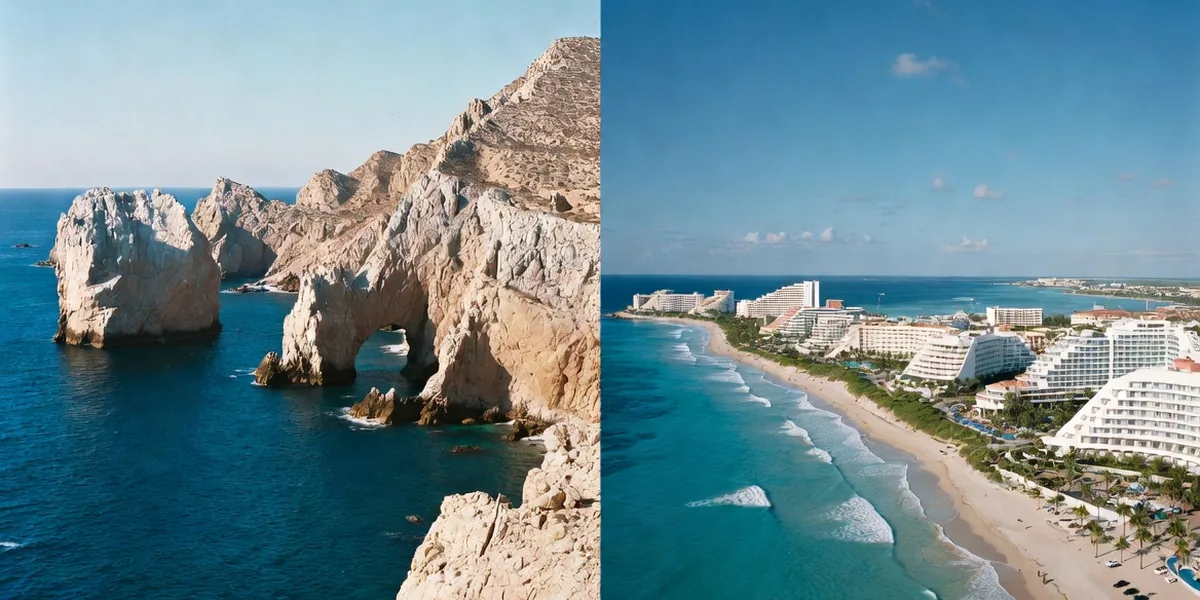
This is the comparison most people are actually making — Mexico's two flagship beach destinations sit on opposite coasts, attract different crowds, and deliver very different trips. Both are good. They are good at different things, and the wrong choice produces a disappointing vacation. The honest answer to "Cabo or Cancún" depends entirely on what you want from a week off.
Below: the real differences, the questions that actually decide it, and the verdict per traveler type.
Quick Comparison Table
| Category | Cancún | Los Cabos |
|---|---|---|
| Coast | Caribbean (Quintana Roo) | Pacific + Sea of Cortez (Baja California Sur) |
| Beaches | Turquoise water, powder sand, swimmable | Dramatic, desert-meets-ocean, mostly NOT swimmable |
| Sargassum | Yes — peaks April–August | None |
| Price level | Wide range (budget to luxury) | Mid-luxury (limited budget options) |
| Best for | First-timers, families, all-inclusive | Couples, fishing, whales, scenery |
| Day trips | Ruins, cenotes, Isla Mujeres, Tulum | Whale watching, El Arco, Todos Santos |
| Walkability | Hotel Zone is car/bus dependent | San Lucas marina + San José both walkable |
| Nightlife | Massive — Coco Bongo, Mandala | Concentrated — Cabo Wabo, Squid Roe |
| Flight from US | ~3–5 hr, more East Coast nonstops | ~3–5 hr, more West Coast nonstops |
| Sargassum 2026 forecast | Heavy season expected | Unaffected |
The Beaches — Two Completely Different Experiences
This is where the comparison gets unfair, because Cabo and Cancún beaches are not really comparable. They are different categories of thing.
Cancún beaches are the Caribbean cliché in the best sense. Powder-white sand made of crushed coral that stays cool in the sun. Water in genuine turquoise gradients from shore to horizon. Calm, swimmable, snorkel-friendly conditions most days. Playa Delfines, Playa Marlin, and the entire Hotel Zone strand are what people picture when they say "Mexico beach." The Riviera Maya extends this for 130 km south.
Los Cabos beaches are spectacular to look at and largely unsafe to swim. The Pacific side has powerful surf and undertow. The Sea of Cortez side is calmer but most beaches are flagged because of the bottom topography. The reliable swimming beaches in Cabo are: Médano (the main San Lucas beach, calm but crowded), Chileno (a Blue Flag beach on the Tourist Corridor, excellent), Santa María (the snorkeling beach, also Tourist Corridor), and Lover's Beach (boat access only, Sea of Cortez side is swimmable).
What this means in practice: in Cancún you can walk out of any resort and swim. In Cabo, you check the flag color and you may need to take a taxi to a different beach to swim safely. The Cabo beaches that are spectacular for photos — the Pacific stretches with massive waves and dramatic cliffs — are not where you go in the water.
Sargassum — The Most Decisive Factor for 2026
If your trip falls between April and August and you cannot tolerate seaweed on your beach, the question answers itself: go to Cabo.
Sargassum is the brown floating algae that has affected the Caribbean coast of Mexico since 2011, with some years much worse than others. The 2026 season is forecast to be heavy across Quintana Roo. Resorts in Cancún and the Riviera Maya invest heavily in beach cleaning crews, but on bad days the seaweed wins. The water can shift from postcard turquoise to brownish, the smell when sargassum decomposes is unpleasant, and swimming becomes unappealing.
Los Cabos has zero sargassum. The Pacific and Sea of Cortez are not part of the affected ecosystem. If you are booking April–August and want guaranteed clean beaches, Cabo eliminates that variable entirely.
From September through March, sargassum on the Caribbean side is generally not a problem. Both destinations are good options.
Food — Where Cabo Pulls Ahead
Cabo San Lucas and especially San José del Cabo have developed a serious restaurant scene over the past decade. The combination of Sea of Cortez seafood, Baja agriculture (the surprising amount of farmland north of San José produces excellent vegetables, herbs, and cheese), and a wave of chefs who came for the lifestyle and stayed has produced restaurants that hold their own internationally.
San José del Cabo's Art District on Thursday nights is the best concentrated dining experience in either destination. Cabo's taquerías punch above their weight. The mezcal selections in serious bars are deep. Acre, Flora's Field Kitchen, and El Farallón at Pueblo Bonito are destination restaurants — people fly in for them.
Cancún's Hotel Zone has a different story. Most of the food inside the Hotel Zone is resort-controlled, tourist-priced, and aimed at the all-inclusive crowd. The better food is in downtown Cancún (which most tourists never visit) and in Playa del Carmen 70 km south. La Habichuela and Lorenzillo's are the longstanding Hotel Zone exceptions. For most travelers eating exclusively in the Hotel Zone, Cancún food is fine — not memorable.
Per dollar, Cancún is fine. Per experience, Cabo wins clearly.
Activities — What Each Does Best
Cancún and Riviera Maya specialize in:
- Mayan ruins (Tulum, Chichén Itzá, Cobá, Ek Balam)
- Cenote swimming and diving
- Snorkeling and diving the Mesoamerican Reef (the world's second largest)
- Whale shark swimming (Isla Mujeres, June–September)
- Theme parks (Xcaret, Xel-Há, Xplor)
- Day trips to Isla Mujeres, Holbox, Cozumel
Los Cabos specializes in:
- Sportfishing — Cabo is one of the world's top marlin destinations
- Whale watching (December–April, gray and humpback)
- Boat trips to El Arco and Lover's Beach
- Snorkeling at Cabo Pulmo (UNESCO marine reserve, drive 2 hr)
- ATV and dune buggy tours through desert and beach
- Day trips to Todos Santos and the Sierra de la Laguna
- Golf — multiple championship-level courses
The activity question often answers the destination question. If your dream trip involves cenote swimming and a Mayan ruin sunrise, Cancún is the answer regardless of anything else. If your dream involves landing a marlin or watching humpbacks breach next to the boat, Cabo is the answer.
Nightlife
Cancún's Hotel Zone has the largest concentration of clubs in Mexico. Coco Bongo, Mandala, La Vaquita, and Palazzo run on a Vegas-club model with international DJs and elaborate productions. The party scene is huge, varied, and goes until 4–5 AM consistently.
Cabo San Lucas marina is more concentrated — Cabo Wabo (Sammy Hagar's bar, still operating), Squid Roe, Mandala Cabo, El Squid Roe. The party here is louder per square foot than in Cancún but the footprint is smaller. It is famously intense during spring break.
San José del Cabo, by contrast, is wine bars and quiet rooftops. Two destinations within Los Cabos for two different vibes.
Edge to Cancún for sheer scale; Cabo if you want everything within a 10-minute walk.
Walkability and Layout
This is the underrated factor that separates the trips.
Cancún Hotel Zone is a 22 km strip of resorts on a barrier island. You are essentially in your resort or in a taxi. The bus runs but it is not the experience most travelers want. Walking between hotels is unpleasant — there are no real pedestrian sections except a few short shopping plazas. Most people end up at the resort all day, take an organized excursion, and consider that the trip.
Cabo San Lucas marina is genuinely walkable. The marina, restaurants, bars, shops, and Médano Beach are all within a 15-minute walk. You can stay at a downtown hotel and never use a taxi.
San José del Cabo is even better — a real Mexican town with a colonial center, art galleries, and a walkable historic district. The 30-minute drive between San José and Cabo San Lucas via the Tourist Corridor is the spine of Los Cabos and the resorts in between (Chileno Bay, Esperanza, Las Ventanas) are some of the highest-quality in Mexico.
If you want a destination where you can walk to dinner without planning, Cabo wins clearly. The Hotel Zone's resort-bubble structure is a real limitation for some travelers.
Going to Cancún and want to escape the Hotel Zone? The honest comparison with PDC: Cancún vs Playa del Carmen.
Prices — Cancún Wins, Substantially
Cancún is meaningfully cheaper than Cabo across nearly every category:
- Flights: 20–40% cheaper from most US cities
- All-inclusive rates: Comparable quality runs $100–200/night less per couple
- À la carte hotels: Cancún has real budget options ($80–120/night for clean 3-star); Cabo's floor is closer to $180–250
- Excursions: Snorkel tours, ruins day trips run $50–100 in Cancún; comparable Cabo activities (whale watch, sunset cruise) run $100–180
- Food: Cancún Hotel Zone is overpriced, but downtown Cancún and Playa del Carmen offer good food at half Cabo's prices
- Taxis: Cabo taxis are notoriously expensive — short hops cost $15–25
The price gap is real and it shows up across the trip. A 7-night couples trip to a comparable 4-star all-inclusive runs roughly $1,000–1,500 less in Cancún than Cabo, before factoring in flight differences. For families, the gap widens.
This is why Los Cabos has positioned itself toward the upper-mid and luxury market — true budget travelers do not have many options. If your budget is tight, Cancún or the Riviera Maya is where the math works.
Weather and Seasons
Cancún: Tropical. Hot and humid year-round. Hurricane season June–November (most active August–October). Rainy afternoons common May–October. Best weather: December–April.
Los Cabos: Desert climate. Dry, sunny, less humid. Cooler December–February (highs 75°F, lows 55°F). Hot June–October. Hurricane season is shorter and Cabo has been hit hard occasionally (Hurricane Odile, 2014). Best weather: October–May.
Cabo's December–March weather is more comfortable than Cancún's because of lower humidity and cooler nights. If you run hot or hate humidity, Cabo is the answer.
The Verdict
Choose Cancún (or Riviera Maya) if:
- You want the iconic Caribbean turquoise water
- You are traveling with kids who need easy swimming
- Budget is a real constraint
- You want all-inclusive variety
- You care about ruins and cenotes
- It is your first Mexico beach trip
- Whale shark season (June–September) is on your list
Choose Los Cabos if:
- You are traveling April–August and want to avoid sargassum entirely
- You want desert-meets-ocean scenery you cannot get in the Caribbean
- Whale watching (December–April) is the priority
- You want serious sportfishing
- You want a walkable destination, not a resort bubble
- You want a more mature dining and bar scene
- You want lower humidity and a desert climate
- Budget is not the deciding factor
For couples on a bigger budget who want a memorable, distinctive trip — Cabo. For families and first-timers who want easy logistics and the postcard Caribbean — Cancún. For travelers between those poles, the question becomes "do you want sargassum risk or do you want to pay 30% more?"
Both are good destinations. They are good at different things. Match the destination to the trip you actually want.
Frequently Asked Questions
Cancún for first-timers who want easy logistics, all-inclusive resorts, postcard Caribbean water, and day trips to ruins and cenotes. Los Cabos for first-timers who want desert-meets-ocean scenery, world-class fishing or whale watching, and a more grown-up vibe with fewer megaresorts. Cancún is easier; Los Cabos is more distinctive.
Different categories. Cancún has the iconic turquoise Caribbean water and powder-white sand most people picture when they imagine 'Mexico beach.' Los Cabos has dramatic desert cliffs meeting two oceans (Pacific and Sea of Cortez), but most Cabo beaches are not safe for swimming due to strong currents. If swimming and lounging are the priority, Cancún wins. If scenery and boat-access coves are the priority, Los Cabos wins.
Cancún is meaningfully cheaper across the board. Flights from most US cities are 20–40% lower, all-inclusive rates run lower per night for comparable quality, food and excursions cost less, and the Riviera Maya gives you a wide budget range. Los Cabos has mostly priced itself into the upper-mid and luxury tiers — true budget options are limited.
No. Sargassum is a Caribbean problem. Los Cabos sits on the Pacific and Sea of Cortez and is unaffected. If sargassum season (April–August) is a concern, Cabo is the safer bet — Cancún and the Riviera Maya can have heavy seaweed during peak months despite resort cleanup efforts.
Los Cabos has the more interesting restaurant scene — strong farm-to-table movement, excellent seafood, world-class taquerías in San José del Cabo, and a serious mezcal and craft cocktail culture. Cancún's Hotel Zone food is largely resort-centric and tourist-priced; the better food in the region is in downtown Cancún and Playa del Carmen. Per dollar, Cancún is fine. Per experience, Cabo is better.
Cabo San Lucas marina has the louder party scene — bar crawls, clubs, and the famous spring break energy. Cancún's Hotel Zone has clubs like Coco Bongo and Mandala that draw international crowds. Cancún edges Cabo for sheer volume and variety; Cabo is more concentrated and arguably more intense.
Only at specific beaches. Most of Cabo's beaches face open ocean with strong currents and undertow — they are flagged as not safe for swimming. The reliable swimming beaches are Médano (Cabo San Lucas main beach), Chileno, and Santa María on the Tourist Corridor. Lover's Beach is swimmable on the Sea of Cortez side. Always check the flag system — black flags mean stay out.
From most US cities, Cancún and Los Cabos take similar flight times — roughly 3–5 hours from major hubs. Cancún has more direct flights from East Coast and Midwest cities; Los Cabos has more direct flights from West Coast cities. Both have plenty of nonstops in season.
Los Cabos, by a significant margin. Gray and humpback whales migrate through the Sea of Cortez and Pacific from December to April, and Cabo is one of the most reliable whale-watching destinations in the world. Cancún has whale shark season (June–September) which is its own incredible experience, but for traditional whale watching, Cabo is the answer.
Cancún for most families — calmer Caribbean swimming, more all-inclusive options with kids' clubs, easier logistics, and day trips to family-friendly attractions like Xcaret and Xel-Há. Los Cabos works for families with older kids who can handle the swimming restrictions and enjoy fishing, ATV tours, and whale watching. Cabo is not the obvious choice for toddlers.