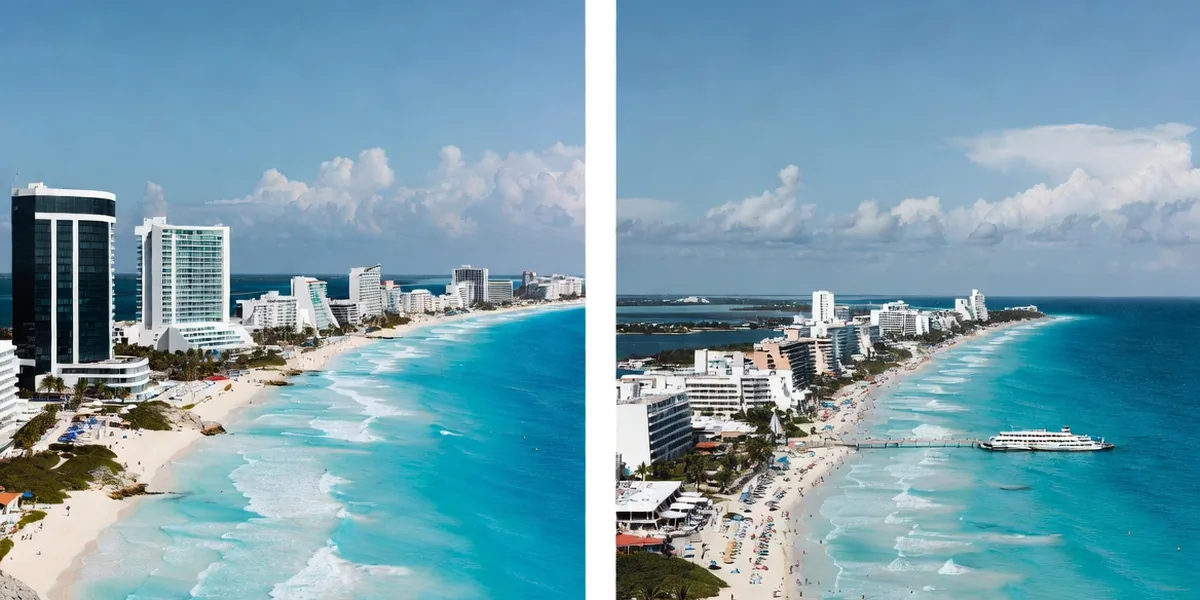
Short answer: Choose Cancún if the beach is the priority, you want a full-service all-inclusive, or you are traveling during sargassum season (May–August). Choose Playa del Carmen if you want better food, lower prices, walkability, and a base for cenotes, Cozumel, and Tulum. Cancún has objectively better Hotel Zone beaches. PDC has objectively better food and is 20–40% cheaper. Neither is wrong. The rest of this page is the receipts — beaches, sargassum, prices, walkability, day trips, nightlife, and the split-trip that uses both.
I get this question more than any other on the Caribbean side. The honest answer: I sleep in Playa del Carmen and day-trip to Cancún for the beaches. PDC for the food, the walkability, the Cozumel ferry, and the fact that I am not negotiating a taxi every time I want dinner. Cancún for the beaches in summer when sargassum hits the Riviera Maya harder. The only wrong move is booking either as a sealed all-inclusive and never leaving the property — you would have the same trip in the Dominican Republic.
Cancún vs Playa del Carmen at a Glance
Is Cancún or Playa del Carmen better for families?
Cancún is better for families with kids under 12 — calmer Hotel Zone beaches, big all-inclusive resorts with kids clubs, and the airport is 20 minutes away. Playa del Carmen is better for families with teens — walkable Quinta Avenida, more day-trip options to cenotes and Tulum, and no resort-bubble feel.
| Factor | Cancún | Playa del Carmen | Winner |
|---|---|---|---|
| Beaches | Wider, more dramatic | Narrower; sargassum hits harder | Cancún |
| Sargassum risk (May–Aug) | Lower — north-facing | Higher — east-facing | Cancún |
| Food scene | Good downtown, bad in Hotel Zone | Walkable, consistently better | PDC |
| Nightlife | Mega-clubs, high energy | More variety, easier to navigate | Tie |
| Hotel prices | Higher, especially Hotel Zone | 20–40% cheaper equivalent quality | PDC |
| All-inclusives | More options, larger scale | Smaller, often boutique-style | Cancún |
| Walkability | Low — Hotel Zone needs transport | High — most things within 15 min | PDC |
| Day trips | Add 45 min to most | Closer to Tulum, Cozumel ferry | PDC |
| Crowds | High in Hotel Zone | High on 5th Ave, quieter off it | PDC |
| Airport access | CUN — 25 min to Hotel Zone | CUN is 1 hr away | Cancún |
| Safety | Tourist Police + National Guard | Well-policed tourist core | Tie |
| Best for | Beaches, resorts, mega-nightlife | Food, budget, town feel, flexibility | — |
Pick in 30 Seconds: Who Should Choose Each
- The beach is the main reason for the trip
- You are visiting May through August (sargassum season)
- You want a full-service all-inclusive with everything on-site
- You want mega-club nightlife (Coco Bongo, The City)
- You have very young kids and prefer calm protected coves
- You do not want to think about logistics
- Food matters as much as the beach
- You want to walk to dinner, drinks, and the ferry
- Budget is tight (20–40% cheaper across the board)
- You plan to day-trip to cenotes, Cozumel, or Tulum
- You prefer a town with locals over a tourist strip
- You are traveling October through April
The top-voted answer came from someone with two Cancún trips and four or five Playa trips behind them: Cancún's beaches are hard to beat, but Playa is the better time if you would rather explore restaurants and bars than live inside an all-inclusive.
The comparison that kept coming up: Cancún reads like Miami Beach — pure resort energy — while Playa is a town you actually walk around. One visitor's favorite memory was a live band and a bucket of Coronas for $10 a block off Quinta Avenida while the rest of the family shopped.
A verified local added the geography behind the beach gap: Cancún sits outside the barrier reef, so the sand is wider and the waves stronger; everything south of it sits inside the reef, so the water is calmer. And when locals in Playa want the nicest sand, they skip town entirely and head to Xpu-Há.
Mr. Playas' read: the thread lands where I do. Cancún for the beach itself, Playa for everything around the beach — and the split-trip crowd in the comments was the happiest of all.
From a discussion on r/playadelcarmen.
Beaches — Cancún Wins, and It Is Not Close
Cancún's Hotel Zone beaches — Playa Delfines, Playa Chac Mool, Playa Marlín — have wide white sand, powerful turquoise water, and a scale that earns the reputation. Playa Delfines in particular is one of the most visually impressive urban beaches in Mexico: free entry, no vendors crowding the sand, no resort blocking the view. The Hotel Zone stretches 22 kilometers along a barrier island with Caribbean Sea on one side and the Nichupté Lagoon on the other.
Playa del Carmen's beaches are pleasant but narrower, more commercial, and more exposed to sargassum. The main beach along Fifth Avenue is lined with beach clubs that charge for access, and the sand width has been shrinking due to erosion in recent years. There are good stretches — Playacar to the south is wider and calmer — but the overall beach experience does not compare to the Hotel Zone.
The sargassum factor makes this gap wider during summer months. Cancún's Hotel Zone beaches face north-northwest and accumulate significantly less seaweed than PDC's east-facing shore. From May through August, the difference can be dramatic: clean water in Cancún's northern zone while PDC's beaches are lined with brown seaweed.
Sargassum in 2026 — The Single Biggest Trip-Breaker
If you are visiting between May and September, sargassum should be the deciding factor. The brown seaweed has become an annual reality on Mexico's Caribbean coast, and the difference between Cancún's Hotel Zone and Playa del Carmen during a heavy bloom is the difference between a postcard beach and a pile of decomposing kelp at the waterline.
Cancún's Hotel Zone advantage is geographic: the northern stretch (around Playa Las Perlas and the Hotel Zone's northern tip) faces north-northwest, away from the prevailing currents that push sargassum onto the coast. Hotels in this zone — broadly, kilometer markers 1–7 — see meaningfully less seaweed. The southern Hotel Zone (around Playa Delfines, kilometer 18+) faces more directly into the current and accumulates more.
Playa del Carmen and the Riviera Maya face directly east into the Yucatán Current. Tulum and Akumal are typically the worst hit. PDC sits in the middle in severity — better than Tulum, worse than Cancún's north Hotel Zone.
Practical rule for 2026: in sargassum season, book Cancún in the northern Hotel Zone. Outside sargassum season (October through April), the difference is largely irrelevant — both look like the postcards.
Food — Playa del Carmen Wins, Decisively
Cancún's Hotel Zone is a culinary dead zone. Overpriced chain restaurants, hotel buffets, and $25 tacos served to people who do not know the difference. Downtown Cancún (El Centro) has genuinely good food at honest prices — Parque de las Palapas for street tacos, the taco stands along Avenida Tulum — but getting there from the Hotel Zone means a $10 taxi or a 30-minute bus ride. Most resort visitors never make the trip, and they eat badly for a week as a result.
Playa del Carmen's food scene is walkable. El Fogón for al pastor tacos (arguably the best on the coast), El Pirata for ceviche and whole grilled fish, La Cueva del Chango for breakfast — all within a 10-minute walk of most accommodation. The density of quality food per block is higher in PDC, the price differential from Hotel Zone Cancún is significant, and the variety is better. Mexican, Italian, seafood, Asian fusion, mezcal bars — PDC has a culinary depth that Cancún's Hotel Zone cannot match.
The move that changes everything: if you stay in Cancún but eat downtown instead of the Hotel Zone, you get the best beaches and the best food. Requires effort most people will not make.
Full restaurant breakdown, with prices and exact locations: Playa del Carmen restaurants.
Nightlife — Depends What You Want
Cancún wins for scale and spectacle. Coco Bongo, The City, Mandala — massive venues with open bars, live entertainment, pyrotechnics, and thousands of people. This is the spring-break energy that Cancún built its international identity around. Loud, expensive ($50–80 USD for open bar packages), and worth experiencing once. Full Cancún nightlife guide here.
Playa del Carmen has its own Coco Bongo (smaller, same concept), but also Zenzi beach bar for live music on the sand, Mambo Cafe for live salsa, a craft beer scene centered on Cervecería Patito, and a mezcal bar culture that has developed significantly in the last few years. The variety is higher and the price of entry is lower. Cover charges run $10–30 versus Cancún's $50–80.
If you want one huge, memorable night out: Cancún's Club Zone. If you want to go out three or four different nights with different vibes each time: PDC is more functional and significantly cheaper.
All-Inclusive Resorts — The Real Difference
Cancún has more all-inclusive options at larger scale. The Hotel Zone is wall-to-wall mega-resorts — Hard Rock, Riu, Iberostar, Hyatt Ziva, Moon Palace, the Royal — with the volume and competition that occasionally drive aggressive low-season pricing. If you want the resort to be the trip — every meal, every drink, every activity inside the property line — Cancún has more density and more aggressive promotions.
Playa del Carmen's all-inclusives skew smaller and more boutique. Mahekal, Grand Hyatt PDC, the Royal Playa del Carmen, Ocean Riviera Paradise, and the Paradisus collection are all walkable to (or extremely close to) Fifth Avenue. The advantage: you can leave the resort for dinner and actually walk somewhere worth walking to. The disadvantage: less inventory, slightly higher prices for equivalent quality.
The honest take: if you genuinely will not leave the resort, Cancún. If you want the option to walk out the gate and find good food without a taxi, PDC.
Full breakdown of every Playa del Carmen all-inclusive — what's worth booking and what to skip: Playa del Carmen all-inclusive guide.
Prices — Playa del Carmen Is Cheaper Across the Board
A mid-range hotel in Cancún's Hotel Zone runs $180–350/night. Equivalent quality in PDC runs $120–220/night — that is a 20–40% savings. Boutique hotels in PDC's center, a 5-minute walk from the beach and restaurants, deliver a better experience at a lower price than Cancún's mid-tier Hotel Zone properties.
Food follows the same pattern. A restaurant meal for two with drinks in Cancún's Hotel Zone averages $60–100 USD. The same quality meal in PDC averages $35–60 USD. Street food in both places is cheap ($1–3 per taco), but you have to leave the Hotel Zone to find it in Cancún while it is everywhere in PDC.
The exception: all-inclusive resorts. Cancún has more all-inclusive options and the competition occasionally drives better deals during low season. If you are booking a pure all-inclusive week where you never leave the resort, the pricing can be comparable. But at that point the Cancún vs PDC question does not matter — you are paying for the resort, not the destination.
Walkability — PDC Is a Town, Cancún Is a Strip
This is the single biggest lifestyle difference between the two. Playa del Carmen is walkable in a way that Cancún simply is not. Your hotel, the beach, restaurants, bars, shops, and the Cozumel ferry dock are all within a 15-minute walk in PDC. You can spend an entire week without getting in a car or taxi.
Cancún's Hotel Zone is a 22-kilometer strip. Getting from your resort to a restaurant requires a bus or taxi. Getting from the Hotel Zone to downtown Cancún (where the real food is) takes 20–30 minutes. The R-1 and R-2 public buses run the length of Boulevard Kukulcán for about $0.70, which helps — but the fundamental geometry of the Hotel Zone means you are always in transit between activities.
This matters more than most people realize. In PDC, an afternoon drifts naturally from lunch to beach to shopping to drinks. In Cancún, each transition requires transportation planning. Over a week, the cumulative friction adds up.
Doing cenotes without a rental car? The ranked guided options from Cancún and Playa: Best cenote tours from Cancún.
Day Trips — PDC Has the Better Position
Both give you access to the same core Riviera Maya attractions — cenotes, Tulum ruins, Sian Ka'an, Xcaret parks. But PDC puts you closer to most of them. The Cozumel ferry departs from PDC's pier (45-minute crossing). Akumal is 30 minutes south. Tulum is about 1 hour. Cenotes like Dos Ojos and Gran Cenote are 45 minutes to 1 hour.
From Cancún's Hotel Zone, add 45 minutes to an hour to most of those numbers. Chichén Itzá is roughly equidistant from both (2.5–3 hours). The difference is not a dealbreaker, but if day trips are a significant part of the trip — cenotes, Cozumel, Tulum, Akumal snorkeling — PDC's position saves meaningful time across multiple days.
Cenotes near Cancún — organized by distance, difficulty, and entrance fees: Cancún cenotes guide.
Cancún or Playa del Carmen for Couples?
PDC for couples who want to walk to dinner, share a bottle of wine on a rooftop, and end the night without negotiating a taxi. The town's density means a date does not require a logistics plan — you walk out the hotel, find a restaurant, walk to a mezcal bar, walk home. Adult-only boutique hotels in the center (Be Playa, Thompson, the smaller Mayakoba properties just north) are built for this.
Cancún wins for couples who want a sealed all-inclusive — spa appointments, beachfront butler service, swim-up suites, no decisions. Adults-only properties like Le Blanc, Live Aqua, and Secrets the Vine deliver this at scale. The trade-off: you are inside the property line for the week.
Cancún or Playa del Carmen for Families?
Both work. Cancún edges ahead for families with very young children — calmer water in protected Hotel Zone coves (the bay-facing beaches near kilometer 3–4 are essentially flat), more kid-focused all-inclusives with kids' clubs and water parks on-site (Moon Palace, Hard Rock, Hyatt Ziva), and fewer logistical demands on parents.
PDC edges ahead for families with older kids and teens. Walkability means kids can grab ice cream on Fifth Avenue, parents can sit at a café, and the trip does not depend on the resort's animation team. Cozumel and Xcaret are both easier day trips from PDC, and older kids will get more out of leaving the property than staying inside it.
Safety — Both Are Fine for Tourists
This comes up constantly and the answer is straightforward: both are generally safe for tourists, with standard precautions. Cancún's Hotel Zone is one of the most heavily policed tourist zones in Mexico — dedicated Tourist Police, 24/7 National Guard patrols, and an economic incentive to keep the area safe because the entire local economy depends on it.
Playa del Carmen's tourist core along Fifth Avenue and the surrounding blocks is well-policed and well-lit. The city has had isolated security incidents in recent years (as has Cancún), but the tourist areas remain functional and safe for the vast majority of visitors.
Standard rules for both: stay in tourist areas after dark, use authorized taxis or ride apps, do not flash expensive jewelry, and avoid buying drugs from strangers on the street (this should be obvious but apparently is not). Neither destination is dangerous for normal tourist behavior.
How Far Is Playa del Carmen from Cancún?
About 68 km (42 miles) south of Cancún, roughly 1 hour by car via Highway 307. This matters because both destinations use the same airport — Cancún International (CUN). From the airport, the Hotel Zone is about 25 minutes. Playa del Carmen is about 1 hour.
Transport options: ADO buses run from the Cancún airport directly to Playa del Carmen every 15–30 minutes, costing about $12–15 USD one way. Colectivo vans from downtown Cancún to PDC are cheaper ($2–3 USD) but do not serve the airport. Private transfers run $60–90 for up to 4 passengers. Renting a car is the most flexible option if you plan to day-trip, starting around $25–35/day.
Many travelers split their trip between both — a few days at a Cancún all-inclusive for the beach, then move to PDC for the food, walkability, and day trip access. The 1-hour drive makes this easy.
Is Playa del Carmen in Cancún?
No — and this confusion comes up enough to be worth answering directly. Playa del Carmen is its own city, in its own municipality (Solidaridad), 68 kilometers south of Cancún. Both are in the state of Quintana Roo, both share the Cancún International Airport, and both sit on the same stretch of Caribbean coastline known as the Riviera Maya. That shared airport is the main source of the confusion. They are an hour apart by road and have completely different character — Cancún is a planned tourist resort city, PDC is an organic town that grew up around a ferry dock to Cozumel.
Can You Do Both Cancún and Playa del Carmen in One Trip?
Yes, and it is a good strategy. The most common split: 3–4 nights in Cancún for the beach and resort experience, then 3–4 nights in PDC for the food, the town vibe, and day trips to Cozumel and cenotes. You get the best of both without committing to the weaknesses of either.
The logistics are simple. ADO bus or a colectivo van between the two costs under $15. A rental car gives you even more flexibility. Some travelers do it in reverse — PDC first for the active, exploratory days, then Cancún to decompress on the beach before flying home.
What About Los Cabos? (If You Are Comparing Three)
If your real question is broader — Caribbean vs Pacific — Los Cabos is a different category of trip. Cancún and Playa del Carmen are warm Caribbean water, white sand, cenotes, and Maya ruins. Los Cabos is dramatic desert-meets-sea landscape, cooler Pacific water, sportfishing, and a more upscale resort scene. There is no sargassum on the Pacific side. Beaches in Cabo are mostly not swimmable (strong currents) — they are for looking at. Caribbean side wins if you want to be in the water; Pacific side wins if you want the views and the upscale resort culture. Full breakdown in the Los Cabos vs Cancún comparison.
The Verdict — Which Is Better in 2026?
Choose Cancún if the beach is the priority, you want a full-service resort experience with everything on-site, or you specifically want the mega-club nightlife. The Hotel Zone beaches are genuinely world-class and the convenience is real. If you are visiting during sargassum season (May–August), Cancún's north-facing beaches give you a significant advantage.
Choose Playa del Carmen if you want better food, lower prices, a walkable base, and more flexibility to explore the Riviera Maya without fighting Hotel Zone traffic. PDC is the better platform for a trip that actually uses the region — cenotes, Cozumel, Tulum, Akumal.
The personal answer: PDC every time. But the beaches in Cancún are legitimately better, and for some people that matters more than everything else on this list. Neither is a wrong choice — only the all-inclusive-and-never-leave version is.
Frequently Asked Questions
Cancún for beaches and resorts. PDC for food, budget, walkability, and day trip access. Both are solid — the right choice depends on what matters most to your trip and the time of year.
Playa del Carmen is the safer first-time pick. Walkable, lower learning curve, no constant taxis. Cancún is the safer first-time pick only if you will stay inside a resort.
PDC is nicer for walkability, food, and town atmosphere. Cancún is nicer for beach quality and resort convenience. Different definitions of nice — depends on what you value.
About 68 km (42 miles), roughly 1 hour by car. ADO buses run from the airport every 15–30 minutes for $12–15 USD. Colectivos from downtown Cancún cost $2–3 USD.
No. Playa del Carmen is a separate city 68 km south of Cancún. Both share the Cancún airport (CUN), which causes the confusion. Same state, same coastline, different cities.
Cancún wins. The Hotel Zone beaches are wider, more dramatic, and less affected by sargassum. PDC's beaches are narrower and get hit harder by seaweed, especially May through August.
Both are generally safe for tourists. Cancún's Hotel Zone has dedicated Tourist Police and 24/7 National Guard. PDC's tourist core is well-policed. Standard precautions apply to both.
Yes — by 20–40% across hotels, restaurants, and nightlife. Equivalent-quality hotels run $120–220/night in PDC versus $180–350 in Cancún Hotel Zone. Restaurant savings are similar.
Worse in Playa del Carmen. PDC's east-facing beaches catch more sargassum than Cancún's northern Hotel Zone, which faces north-northwest. May through August is peak sargassum season.
Yes, and many travelers do. A common split: 3–4 nights in Cancún for the beach, then 3–4 nights in PDC for food and day trips. The drive between them is about 1 hour.
PDC for couples who want to walk to dinner and not negotiate taxis. Cancún for couples who want a sealed adults-only all-inclusive with full service. Both work — different style of romance.
Both work. Cancún edges ahead for very young children (calmer water, kid-focused resorts). PDC edges ahead for older kids and teens (more to walk to, less reliance on resort activities).