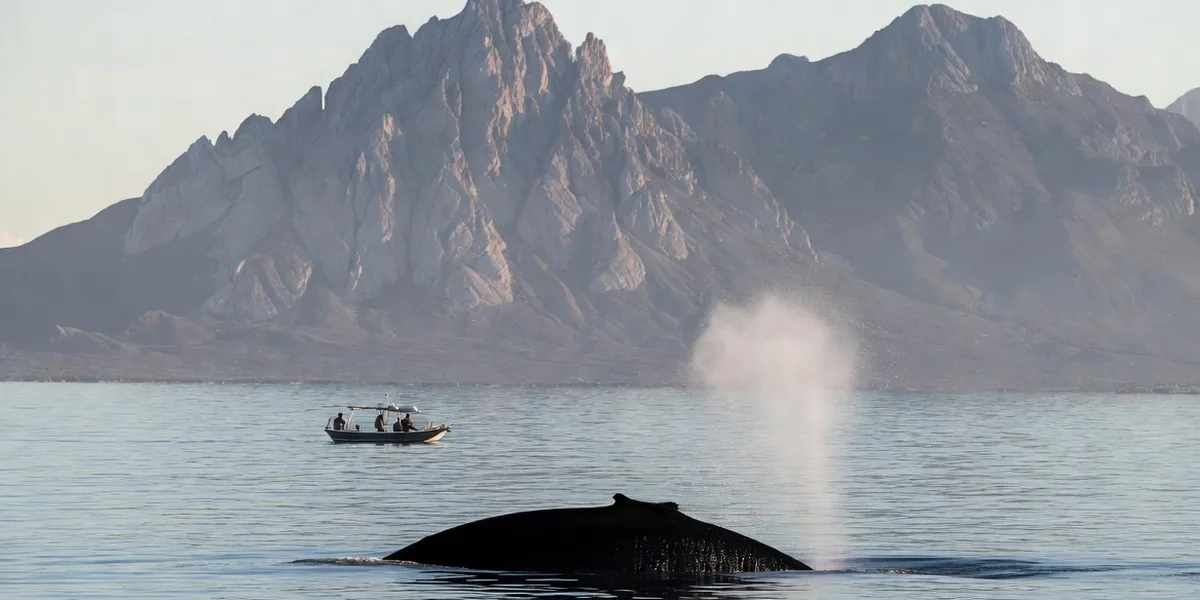
Jacques Cousteau called the Sea of Cortez the world's aquarium. He was not exaggerating. The waters off San Carlos host a marine diversity that ranks among the richest in the Pacific, and from November through March, that diversity includes something extraordinary: humpback whales, fin whales, blue whales, and whale sharks passing through on their annual migration between the cold feeding grounds of Alaska and Canada and the warm breeding lagoons of Baja California Sur.
San Carlos is one of the best points from which to watch this migration — better positioned than Los Cabos for many species, less crowded than the famous Baja California whale-watching lagoons, and with the distinctive backdrop of the desert meeting the sea that makes every photograph look unlike anything else.
Whale Watching Season in San Carlos
The main season runs November through March. This window covers the migration in both directions: whales traveling south from November through January, and returning north from February through April. The peak months for sightings are January and February, when the concentration of whales in the Sea of Cortez is highest and both the southbound and northbound migrations overlap.
Species You Can Expect to See
- Humpback whale — The flagship species. Humpbacks are the acrobats of the whale world — known for breaching (launching their entire bodies out of the water), pectoral slapping, and tail-lobbing. Adults reach 40–50 feet and 30–40 tons. Sightings in January and February are reliable. This is the species most people come for.
- Fin whale — The second-largest animal on Earth, reaching 85 feet. Less acrobatic than humpbacks but remarkable in scale — seeing a fin whale surface next to a small boat recalibrates your understanding of size. Regularly seen in the deeper waters of the Sea of Cortez throughout the season.
- Blue whale — The largest animal that has ever existed on Earth — up to 100 feet and 150–200 tons. Sightings are occasional but real. The Sea of Cortez is one of the few places in the world where blue whales can be found with any regularity.
- Gray whale — The great migrators. Gray whales travel 10,000 miles each way between Alaska and the breeding lagoons of Baja California. They pass through waters near San Carlos from December through February.
- Common dolphins and bottlenose dolphins — Year-round residents. Dolphin encounters during whale watching tours are extremely common — often the pods ride the bow wave of the boat voluntarily.
Why the Sea of Cortez?
The Sea of Cortez functions as a natural migration corridor with cold, nutrient-rich upwelling zones that produce massive concentrations of krill, anchovies, and sardines — the primary food source for baleen whales. The whales feeding here in winter are fueling up for the breeding season further south. San Carlos sits at a latitude that catches both the feeding aggregations in the channel and the migration traffic in the deeper water.
Choosing a Tour
Most whale watching tours out of San Carlos run 3–4 hours and depart from the marina. The boat sizes range from small pangas (4–8 people, more maneuverable, cheaper) to larger cabin cruisers (10–20 people, more comfortable, more expensive). For whale watching specifically, smaller boats get you closer to the action and provide a more immediate experience.
What to look for in an operator: a licensed captain with whale watching experience, a route that covers the deeper channel water where whale concentrations are highest, and a guide who can identify species and explain behavior. The price difference between a good operator and a basic one is modest — do not optimize on price for this experience.
Tour prices: $60–100 USD per person for a shared tour (3–4 hours). Private charter for 4–8 people: $400–700 USD. Book in advance for January and February — the best operators fill up.
What to Bring
- Binoculars — Essential. Whales surface and breach at distance before the boat can close.
- Camera with zoom — A zoom of at least 200mm lets you capture breaches. A stabilized lens helps on a moving boat.
- Windproof jacket — In whale season the wind on open water can feel like 50–60°F even when the land temperature is 72°F.
- Sunscreen and hat — The sun reflected off the water is intense even in winter.
- Motion sickness medication — If you are susceptible, take it 30 minutes before departure. The Sea of Cortez channel can be choppy in winter.
Sighting Calendar
| Month | Whales | Dolphins | Other |
|---|---|---|---|
| November | Season begins | Year-round | Sea lions |
| December | Good activity | Year-round | Manta rays |
| January | Peak season | Year-round | Seabirds |
| February | Peak season | Year-round | Sea lions |
| March | Season ends | Year-round | Sea turtles |
| Jul–Oct | — | Year-round | Whale sharks |
Full San Carlos tour guide with current operators and booking info: San Carlos tours and activities.
Frequently Asked Questions
November through March, with peak sightings in January and February. This covers both the southbound migration (Nov–Jan) and northbound return (Feb–Apr). January is the single best month for humpback whale concentration.
Yes. Bottlenose dolphins are permanent residents of the Sea of Cortez off San Carlos. Common dolphins are also present most of the year. Dolphin encounters during boat tours are extremely frequent — often the pods approach the boat voluntarily.
Shared tours: $60–100 USD per person for a 3–4 hour excursion. Private charter for 4–8 people: $400–700 USD. Book in advance for January and February. The better operators fill up quickly during peak season.
Binoculars are strongly recommended — whales surface at distance before the boat closes. A camera with zoom for photography. Windproof jacket for the open water in winter. Motion sickness medication if you are prone. The operator provides all safety equipment.
Yes. Licensed operators maintain regulated distances from the whales. The animals are observed, not pursued or disrupted. Captains in San Carlos who run whale watching tours are experienced with cetacean behavior and know when to hold position and when to move.