Tulum Mayan Ruins: The Complete 2026 Visitor Guide
By Mr. Playas · Updated May 2026
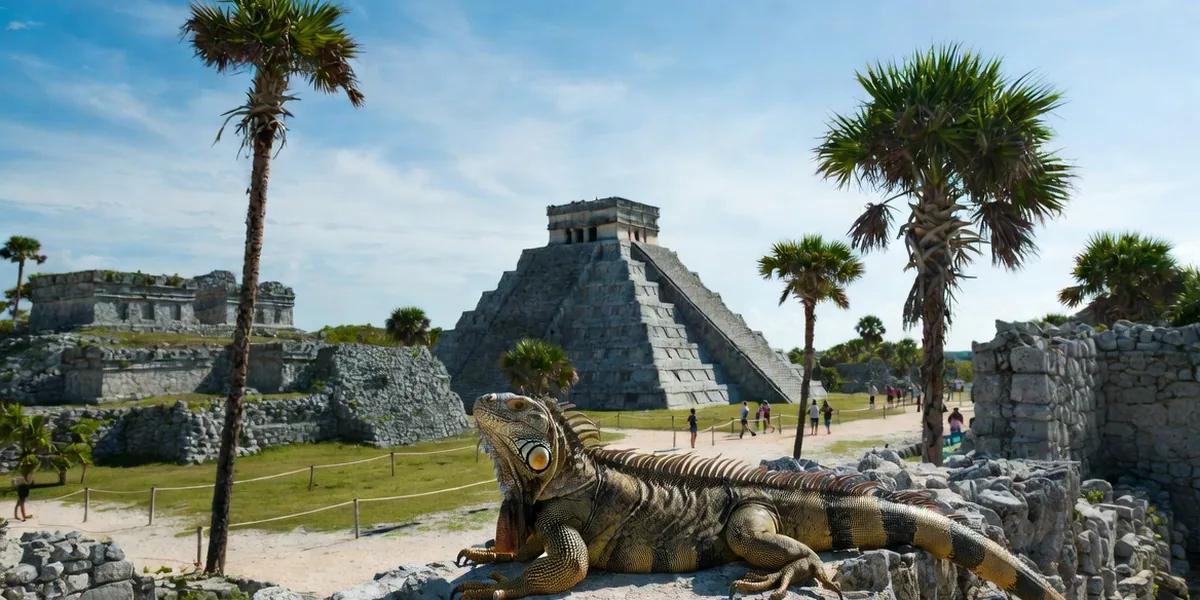
Tulum's archaeological zone is the only major Mayan site on the Caribbean coast — a walled cliff-top port city active from roughly 1200 to 1500 AD, the late-Postclassic period when the Mayan world was in transition. The ruins themselves are smaller and less historically important than Chichén Itzá or Cobá. The setting is what makes them unmissable: 12-meter limestone cliffs above turquoise water, the only Mayan ruin where you can climb down to a beach directly below the temples.
Below: the practical 2026 guide — entry fees and the active scams at the gates, the best arrival time, the six temples worth understanding, and how to combine the ruins with cenotes, Cobá, or Sian Ka'an for a full day. Real prices and direct logistics.
The Quick Facts
- Hours: 8 AM – 5 PM daily (last entry 4 PM)
- Cost: ~$18–20 USD total (federal zone fee + Jaguar Park fee, both cash only)
- Time needed: 1.5–2 hours minimum, 2.5 hours with guide
- Best arrival: 8 AM sharp — beat the tour buses and the heat
- Walking: Flat to gently sloped paths, 1–1.5 km loop
- Climbing: Not permitted on any temple (since 1990s)
- Beach access: Yes (Playa Ruinas, via wooden staircase)
- Drone/GoPro: Prohibited inside the archaeological zone
- Wheelchair: Partial — main paths accessible, beach not accessible
Why Tulum Ruins Are Different (And What That Means for Your Visit)
Tulum was built late — most of the major structures date to 1200–1500 AD, when many other Mayan cities had already collapsed. By the time the Spanish arrived in 1518, Tulum was still active as a coastal trading port handling obsidian from central Mexico, copper from the western highlands, jade, and likely sea-salt and coastal resources. The site is small (3 hectares within walls) compared to Chichén Itzá (5 sq km) or Cobá (80 sq km).
What Tulum has that no other major Mayan site has: oceanfront placement. The ruins sit on 12-meter cliffs above the Caribbean. Three of the six major structures face the sea. The natural break in the offshore reef directly in front of the site allowed Mayan canoes to land at the small inlet beach below — one of the only safe boat landings on this coast. El Castillo doubled as a lighthouse-temple, with fires in its upper chambers guiding canoes through the reef.
For visitors, this means: the photography is unmatched, but the historical scope is limited. Don't come expecting to learn about Mayan civilization broadly — come for the unique coastal setting and pair it with Cobá or Chichén Itzá for fuller historical context. See the Tulum things to do guide for the full day-pairing strategy.
Entry Fees, Tickets, and the Entrance Scam (2026)
As of 2026, Tulum entry is split into two separate fees, paid at two separate booths:
- Federal Archaeological Zone fee — paid at the INAH ticket booth at the main entrance. About 100 pesos (~$5–6 USD). Cash only. This is the official ruins entry.
- Jaguar National Park fee — paid at the park entrance booth (different building). About 250 pesos (~$13 USD). Cash, sometimes card. This is required because the ruins sit inside Parque Jaguar, a national park established in 2022.
Total: roughly $18–20 USD per person. Both fees are mandatory; you cannot enter the ruins without paying both. The Jaguar Park fee includes shuttle service from the main entrance to the archaeological zone (about a 10-minute walk otherwise).
The Best Time to Arrive (And Why Time of Day Matters Enormously)
Arrive at 8 AM sharp. This is the single most important piece of practical advice for visiting Tulum. The site opens at 8; the first tour buses from Cancún arrive between 10 and 11 AM. The two-hour window from 8 to 10 AM gives you:
- Cooler temperatures (75–82°F vs 92–98°F by noon)
- Soft east-facing morning light on the seaward temples
- Photos without crowds (especially of El Castillo)
- Time to walk down to Playa Ruinas before the beach fills
- The ability to listen to a guide without competing tour-group volume
By 11 AM, the site is at peak capacity. By noon, it's brutal in the sun (the entire site has almost no shade — the original tree canopy was cleared centuries ago). By 2 PM, most visitors have left for cenotes or lunch. The site stays open until 5 PM but the afternoon experience is not what people remember from photos.
The Six Temples Worth Understanding
Most visitors walk the full circuit in 90 minutes, photograph El Castillo and the seafront, and leave. With 30 extra minutes you can engage meaningfully with each major structure. Below: the six worth a deliberate stop.
El Castillo (The Castle)
Centerpiece of the site · 8-meter pyramid · 1,060 Google reviews · 4.8 rating
The largest and most photographed structure at Tulum. El Castillo sits at the edge of a 12-meter limestone cliff overlooking the Caribbean. Beyond its ceremonial function, archaeological evidence suggests it doubled as a navigational aid — fires lit at night in the upper chambers guided Mayan canoes safely through the only natural break in the reef.
- Visible from the modern town and the sea
- Built in stages between the 13th and 15th centuries
- Climbing the structure is prohibited (since 1990s)
- Best photographed from the southern viewing platform at 8–9 AM
Templo del Dios del Viento (Temple of the Wind God)
Round-base temple · 4.6 rating · Unique architecture
The small round-base structure on the northern edge of the cliff, dedicated to Kukulkán (in his form as the Wind God). The circular base is unusual in Mayan architecture — most temples are square or rectangular. The exposed cliff position means strong sea winds blow through the structure continuously; ancient priests interpreted these winds as divine signals.
- One of only a handful of round-base temples in the Mayan world
- Positioned to catch hurricane warnings — coastal Mayans observed wind patterns
- Drone photography is forbidden inside the archaeological zone
- Excellent sunrise photo position
Templo de la Serie Inicial (Temple of the Initial Series)
Calendar stelae · 4.7 rating · Astronomical alignment
The temple where archaeologists discovered calendar stelae carved with Mayan dates indicating the year 564 AD — one of the earliest dates recorded at any Mayan site in this region. The Initial Series date suggests an earlier Mayan presence at the location centuries before Tulum was developed as a port city.
- Stelae fragments now in the on-site museum
- Walking access only — entry to interior chambers closed
- Best viewed from the elevated path on the seaward side
Gran Plataforma (Great Platform)
Foundation complex · 4.8 rating · Ceremonial center
The Great Platform served as the foundation for several smaller temple buildings and palatial residences for Tulum's elite class. The platform itself was a hub of ceremonial activity — the discovery of obsidian blades, jade ornaments, and ritual artifacts suggests sustained religious practice here over multiple generations.
- Originally supported timber-roofed buildings (long since gone)
- Three-tier hierarchical access pattern visible in foundations
- Late-period addition (post-1300 AD)
Casa del Halach Uinic (House of the Chief)
Elite residence · Inner zone
The residential complex believed to have housed Tulum's ruling Halach Uinic (true man) and immediate family. Multi-room structure with interior plaster work, including murals (now mostly faded). The dimensions and quality of construction differ markedly from common residential structures, indicating the site's social stratification.
- Limited public access — viewable from exterior paths
- Mural fragments preserved under modern roof structure
- Behind El Castillo, often missed by self-guided visitors
Templo del Mar (Temple of the Sea)
Northern sea-facing temple · Ceremonial
A smaller seafront temple on the northern edge of the site, sometimes overlooked because visitors gravitate to El Castillo on the south side. The structure faces directly east, oriented to the rising sun and to the sea — likely associated with maritime trade ceremonies and the dawn rituals essential to Mayan cosmology.
- Equinox sunrise alignment (March 20–21, September 22–23)
- Foundation visible; superstructure largely lost
- Adjacent to the cliff trail down to Playa Pescadores
Playa Ruinas — The Beach Below the Cliffs
A wooden staircase on the eastern edge of the site leads down to Playa Ruinas, a small white-sand beach directly below the cliffs. This is the single best view of El Castillo — looking up from sea level with the temple framed against the cliff and sky. The beach has:
- Fine white sand, calm shallow water (the reef break shelters this section)
- No chair rentals, no umbrellas, no vendors
- Iguanas everywhere on the path down
- Sargassum possible April–August; usually less than at Hotel Zone beaches
Bring a towel, water, and sunscreen. Plan 30–45 minutes here. The staircase can have a 10–15 minute wait at peak times (11 AM–1 PM) — another reason for the 8 AM arrival.
Photography Rules and Realities
The Tulum archaeological zone prohibits:
- Drones (DJI and similar) — confiscated if discovered
- GoPros worn on body (handheld OK)
- Tripods exceeding 30 cm
- Professional photography for commercial use without permit
Allowed: smartphones, mirrorless and DSLR cameras (handheld), action cameras (handheld). Selfie sticks are technically allowed but discouraged due to crowding.
The single best photo position is the wooden viewing platform on the southwest corner of El Castillo — frame the temple with the cliff edge and Caribbean in background, 8–9 AM for best light, no tour-group elbows in the foreground.
Hiring a Guide vs Self-Guided
The Tulum site has minimal signage. Each major structure has a small plaque with basic name and date; there is no detailed historical context. The on-site museum is small and currently underwhelming compared to what's available at Cobá or Chichén Itzá.
Hire a licensed guide if: you want historical context, you're interested in Mayan civilization, you're traveling with curious kids. Cost: $30–60 USD for a 90-minute private tour at the entrance, or $15–25 per person in a small group. INAH-licensed guides wear identification badges; verify before booking.
Skip the guide if: you want the visual experience and photo opportunities primarily, you've read about Tulum in advance, you've already done Chichén Itzá with a guide. The site is small enough to navigate self-guided without missing the major structures.
Tulum Day Tours from Cancún & Playa del Carmen
Compare small-group early-access tours that include the ruins, a cenote, and lunch — typically $90–130 USD with hotel pickup.
The Best Day-Trip Pairings
The ruins alone fill 2 hours including the beach. To make a full day, pair them with one of:
1. Tulum Ruins + Gran Cenote (Best for first-timers)
Start at the ruins at 8 AM, leave by 10:30, drive 15 minutes to Gran Cenote for swimming and snorkeling in the cleanest open-cave cenote in the area. Lunch in Tulum town. Beach time at Playa Las Palmas in the afternoon. Full day, $80–120 USD self-driving or with a guide.
2. Tulum Ruins + Cobá (Best for archaeology lovers)
Tulum ruins at 8 AM, drive 45 minutes northwest to Cobá. Cobá is older, larger, and home to Nohoch Mul, the second-tallest Mayan pyramid in the Yucatán (climbing was permitted until recently — check current status). Bike rentals inside Cobá ($4.50 USD) cover the spread-out site. Plan 3 hours at Cobá. Combined day, $100–140 USD with guide.
3. Tulum Ruins + Sian Ka'an Biosphere (Best for nature lovers)
Tulum ruins at 8 AM, then transfer south to the Sian Ka'an UNESCO biosphere reserve for a boat tour through the mangrove lagoons. Manatees, crocodiles, dolphins (occasionally), and the float-down-the-channel section. Community Tours Sian Ka'an and Yucatan Outdoors are the recommended operators. Full day, $130–180 USD with operator.
4. Tulum Ruins + Cenote Dos Ojos (Best for divers)
Tulum ruins at 8 AM. Dos Ojos cenote — a cave-cenote system that's among the world's longest underground river networks — opens at 9 AM. Snorkel the main cavern; certified cave divers can do the longer cave dives. 1.5 hours at Dos Ojos plus drive time. Self-drive $50 USD/person, with guide $90–130.
Getting There — Transportation Options
From Tulum town
Taxi: 100–150 pesos one way (about $5–8 USD). Bicycle: 30 minutes via the dedicated bike path along Highway 307. Rental car: 10 minutes, parking 100 pesos at the ruins lot.
From Playa del Carmen
ADO bus: 70 pesos, 1 hour, drops at Tulum town from where you taxi or bike to the ruins. Colectivo van: 50 pesos, 1 hour, more frequent than ADO. Rental car: 50 minutes via Highway 307. Tour bus: $50–90 USD with multiple stops.
From Cancún
ADO bus: 280 pesos, 2 hours direct. Self-drive: 2 hours via Highway 307 (toll-free, two-lane stretches but well-paved). Tour bus: $50–80 USD with multiple stops; small-group early-access tours $90–140 USD (the better option).
From Cozumel
Ferry to Playa del Carmen (45 minutes, $20 USD each way), then continue by ADO/colectivo/rental car as above. Full day from Cozumel works tight; consider overnighting in Tulum.
What to Bring (And What Not To)
Bring
- Reef-safe sunscreen — applied 30 minutes before arrival (the site has no shade)
- Sun hat or umbrella — the Yucatán sun at midday is brutal
- 2 liters of water minimum per person
- Cash in pesos — entry fees, optional guide, taxis (some don't accept dollars cleanly)
- Refillable water bottle (single-use plastics restricted in the Jaguar Park area)
- Bug spray (jungle paths can have mosquitoes at dawn/dusk)
- Bathing suit and towel — for Playa Ruinas swim access
- Camera (smartphone or DSLR/mirrorless; no drones)
Don't bring
- Drones — confiscated if discovered
- Glass containers, cans, single-use plastics — restricted in Jaguar Park
- Large coolers — not permitted into the archaeological zone
- Pets — not permitted
Sargassum, Crowds, and Weather by Season
December – April (peak season)
Best weather (80–85°F days, no rain, low humidity). Heaviest crowds — arrive at 8 AM strictly. No sargassum impact on Playa Ruinas. Easter week and Christmas weeks especially crowded.
May – August (sargassum season)
Hot (88–94°F), sargassum present on Playa Ruinas in heavy years (May–July peak). Tour bus crowds heavy in late June (US summer break starts). Plan for 8 AM arrival to manage heat.
September – November (transitional)
September is hurricane season peak — lowest crowds, real weather risk. October–November are sweet-spot months: hurricane season ending, sargassum gone, crowds moderate, temperatures comfortable. The single best window for first-time visitors.
The cliff-top ruins are the iconic Tulum image, but the destination has much more — beaches, cenotes, restaurants, and the eco-luxury hotel zone south of the ruins. See the Tulum complete guide.
Frequently Asked Questions
About $18–20 USD total in 2026 — split into a ~$5 USD federal zone fee and a ~$13 USD Jaguar Park fee. Cash only at both booths.
8 AM sharp when the site opens. Tour buses arrive 10–11 AM; the morning window has the best light, coolest temperatures, and lightest crowds.
Yes — for the unique cliff-top setting above the Caribbean. Smaller than Chichén Itzá or Cobá but the only major Mayan site with an oceanfront setting.
Yes. The wooden staircase leads down to Playa Ruinas. Bring a towel; no chair rentals.
1.5–2 hours minimum (2.5 hours with guide). The site is small but the beach adds 30–60 minutes.
Optional. The site has minimal signage. Licensed guides $30–60 USD private. Self-guided works with prior reading.
Cobá — 45 minutes inland. Older, larger, less crowded, with the Nohoch Mul pyramid as centerpiece.
Yes. Unofficial vendors at the parking lot offer inflated bundles ($85+). Walk past them to the official INAH and Jaguar Park booths inside.
Mr. Playas' Verdict
Tulum ruins are not the most historically important Mayan site. They are unquestionably the most photogenic. Arrive at 8 AM, walk the loop in 90 minutes, descend to Playa Ruinas for 30 minutes, and combine with Gran Cenote or Cobá for the rest of the day. Skip the entrance vendors, pay only at the official booths, ignore the boat-tour upsells. Two hours of your trip, well spent.
Back to Tulum guide