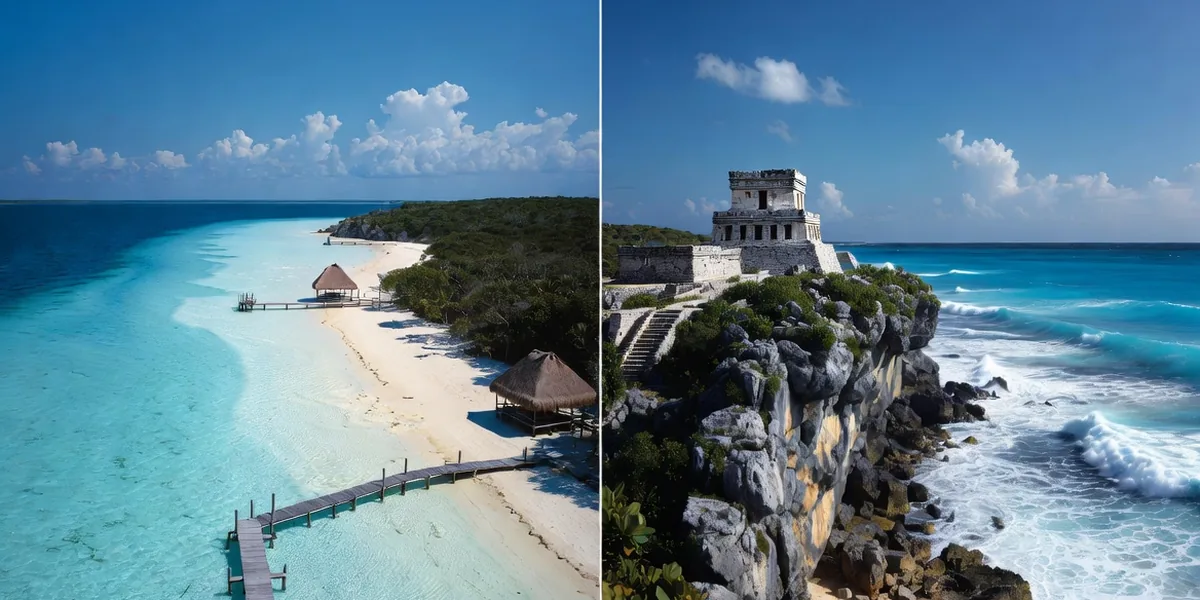
Tulum and Bacalar are both in Quintana Roo, both popular with the same type of traveler, and both frequently described with the word "magical." They are also fundamentally different places that reward different things. One has world-class restaurants and Instagram ruins; the other has cheaper lagoon-front hotels and room to breathe. Here is the honest comparison.
If you are choosing between the two and can only do one: Bacalar for calm, value, and the lagoon. Tulum for the ruins, the cenotes, and the beach — but expect higher prices and bigger crowds. If you have a week: do both. Three nights in Tulum, two in Bacalar. The drive south from Tulum to Bacalar is three hours and the vibe shift is immediate. Bacalar is what Tulum was ten years ago, before the boutique hotels and the DJ brunches.
At a Glance
| Factor | Bacalar | Tulum |
|---|---|---|
| Water | Lagoon of Seven Colors — year-round calm, no sargassum | Caribbean beach — sargassum May–Sept |
| Hotel prices | $80–150/night lagoon-front boutique | $150–300/night beach-zone hotel |
| Food prices | $12–20/person for dinner | $25–45/person, more at top restaurants |
| Crowds | Small town — genuinely quiet | Millions of visitors/year, crowded |
| Activities | Lagoon, boat tours, Fort San Felipe, Cenote Azul | Cenotes, Mayan ruins, Sian Ka'an, beach clubs |
| Nightlife | Minimal | Beach clubs, bars, growing scene |
| Fine dining | Simple Mexican food at fair prices | World-class — Hartwood, Arca, Kitchen Table |
| Distance from CUN | ~4 hrs by car or ADO bus | ~2 hrs by car or colectivo |
| Bioluminescence | Yes — year-round on new moon nights | No |
| Best for | Relaxation, budget, slower pace | Activity-heavy trips, foodie travelers |
The Water
Bacalar's Lagoon of Seven Colors is exactly what it sounds like — seven distinct shades of blue and green caused by varying depths and the white limestone bottom beneath. The water is calm, warm, and swimmable year-round from any dock or lagoon-front property. There is no sargassum: the lagoon is freshwater-fed and enclosed.
Tulum's beaches are Caribbean beautiful on good days — white sand, clear water, jungle ruins on the cliff above. But sargassum accumulation from May through September is a real and persistent problem on this stretch of coast. Some years are manageable; some years the smell reaches the road. Bacalar does not have this issue.
Full breakdown of Bacalar's lagoon zones, best docks, and boat tour options: Bacalar things to do.
Prices
Bacalar is 30–50% cheaper than Tulum across every category. A nice lagoon-front boutique hotel in Bacalar runs $80–150/night. Equivalent quality and positioning in Tulum's beach zone runs $150–300/night. Dinner in Bacalar averages $12–20 per person at a sit-down restaurant. In Tulum, $25–45 is the baseline before you get to the fine-dining tier.
Tulum has become one of the most expensive destinations in Mexico, full stop. The combination of international demand, limited beach road supply, and a clientele that has normalized high prices has made it expensive in a way that does not feel proportional to the experience anymore. Bacalar has not reached that point — yet.
Crowds
Tulum receives millions of visitors per year. The beach road is a traffic jam from December through March. The Tulum ruins — one of the most photographed archaeological sites in Mexico — are packed by 10 AM on any day of the week in high season. The yoga-retreat crowd has been joined by real estate developers, influencers, and bachelor parties. The soul of the original Tulum exists in patches.
Bacalar is a small town of around 15,000 people. You can kayak for an hour on the lagoon and see three other boats. The main street has local restaurants alongside tourist ones. On weekday mornings in low season, the docks are empty. This is the version of Quintana Roo that Tulum used to be.
Things to Do
Tulum has more variety. Cenotes (Gran Cenote, Dos Ojos, Cenote Calavera), the Tulum Archaeological Zone, Sian Ka'an Biosphere Reserve, beach clubs, cooking classes, mezcal bars, and a nightlife scene that has expanded significantly. A week in Tulum can be filled without repetition.
Bacalar has the lagoon — which is itself inexhaustible for activities: boat tours, kayaking, paddleboarding, swimming from the docks, sunset sailboat trips. Fort San Felipe is a colonial-era fortress worth an hour. Cenote Azul is a large cenote just south of town. The bioluminescence on new moon nights. Beyond that, the activity list gets shorter, and that is a feature for the right traveler.
Full guide to timing and booking the bioluminescence tour: Bacalar bioluminescence guide.
Food
Tulum wins on the high end. Hartwood, Arca, and Kitchen Table are genuinely among the best restaurants in Mexico — open-fire cooking, local ingredients, serious wine lists. You are paying $40–80 per person for the experience, and it is worth it if that is what you are after.
Bacalar's food scene is honest: good Mexican food at prices that make sense for a small lakeside town. Fresh fish from the lagoon, tacos from the market, cold beers on the dock at sunset. No $18 smoothies. No cocktail menus with a QR code. The simplicity is intentional.
The Verdict
First visit to the Riviera Maya? Do Tulum — it is still remarkable despite the crowds, and the ruins, cenotes, and Sian Ka'an are genuinely worth the trip.
Already done Tulum, or want something cheaper and quieter? Bacalar is the answer. It is the version of this experience that Tulum was before it became famous — and it will not stay that way indefinitely.
The combination trip — Tulum plus a bus to Bacalar for two or three nights — is the best version of the Yucatan Peninsula for anyone with the time. The ADO bus between them takes about 2.5 hours and costs $12 USD.