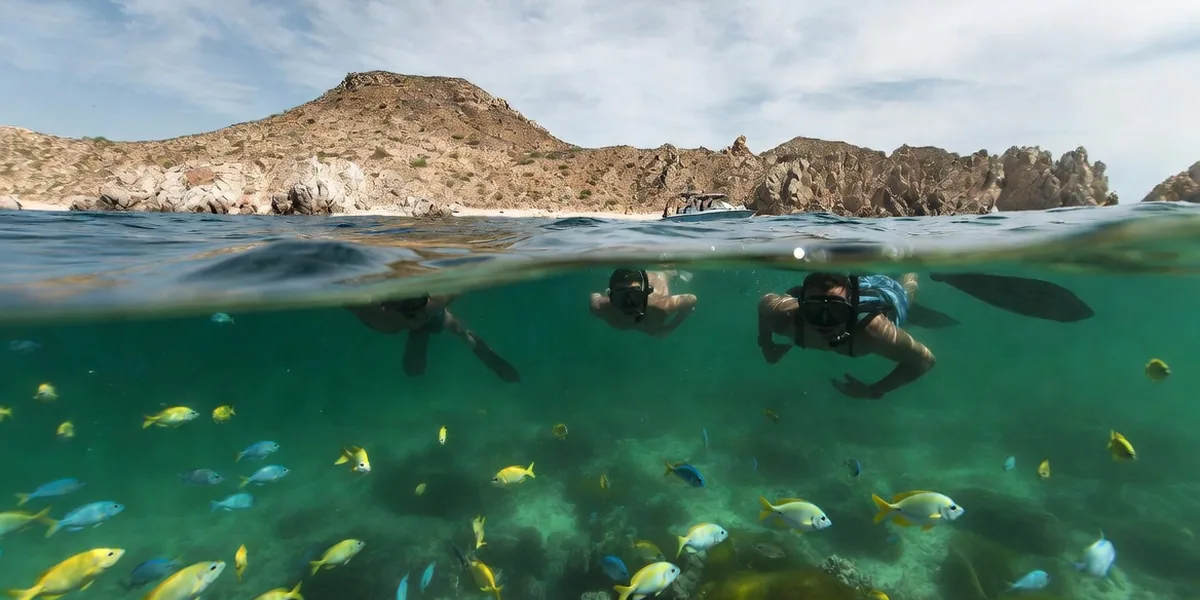
The Sea of Cortez has a marine biodiversity that Jacques Cousteau documented decades ago and that remains exceptional today. The convergence of cold and warm currents at the tip of Baja California creates conditions that concentrate marine life in a way that few regions in the world can match.
This is not brochure copy. It is the reason why snorkeling and diving in Los Cabos are consistently among the best underwater experiences in Mexico, and why they deserve more space in your itinerary than most visitors give them.
If you haven't been to Los Cabos yet, start with our complete Los Cabos guide.
Playa del Amor & the Arch — The Most Accessible Snorkeling
For anyone who wants to get in the water without complications, the area around the Arch and Playa del Amor offers accessible snorkeling with guaranteed tropical fish, sea lions on nearby rocks, and decent visibility throughout most of the year.
You get there by boat from the Cabo San Lucas Marina in about 15 minutes. Many boatmen include snorkel gear in the tour price. The depth in the area is manageable for beginners and no prior experience is needed.
The important warning: Playa del Amor is not for free swimming due to the currents. Snorkeling is done in specific zones that the boatmen know well. Follow the guide's instructions and do not stray from the marked area.
Cabo Pulmo — The Reef That Deserves Its Own Trip
Cabo Pulmo is about 40 miles north of San José del Cabo and is in a completely different category from the tourist snorkeling at the marina.
It is one of three coral reefs in the Gulf of California, protected as a National Marine Park since 1995, and its recovery story after decades of overfishing is one of the most documented marine conservation success cases in the world. What is underwater now is the result of decades of protection: living corals, fish in quantities that surprise, nurse sharks on the bottom, manta rays, and occasionally humpback whales in season.
Access requires a rental car or organized tour from Los Cabos. The certified dive operators in Cabo Pulmo are small, local, and generally more committed to the experience than the mass operators in Cabo San Lucas. Book in advance because groups are small by park policy.
The most biodiverse marine site in Baja. UNESCO World Heritage, bull sharks, whale sharks, and a reef that recovered from near-total collapse. Read the full Cabo Pulmo guide.
Book Snorkeling & Diving in Los Cabos
Arch snorkeling, Cabo Pulmo day trips, whale shark tours from La Paz, and certified dive charters — browse verified operators with free cancellation.
Certified Diving in Cabo San Lucas — For Those Who Want to Go Deeper
If you have a dive certification or want to get one during your trip, Los Cabos has serious operators with access to spots that snorkeling cannot reach. The Sand Fall is one of the most famous underwater phenomena in the area: a cascade of sand that flows from the surface to deep water through an underwater canyon. It is not something you see in many places in the world and it is just minutes from the Cabo San Lucas marina.
The wrecks in the area, including vessels intentionally sunk as artificial reefs, have established marine life colonies and sufficient visibility to make the dives photographically satisfying as well as technically interesting.
Look for operators affiliated with PADI or SSI with instructors holding current credentials. Diving without proper certification in open water is not an adventure, it is an unnecessary risk.
Looking for more activities? Read our guide to things to do in Los Cabos.
Swimming with Whale Sharks — Season and Where to Do It
Whale sharks visit the La Paz area, about three hours from Los Cabos by road, between October and March. They are the largest fish in the world, completely harmless to humans, and swim slowly enough that you can accompany them in the water for minutes at a time.
Operators from Los Cabos organize full-day excursions to La Paz specifically for this purpose. The price includes transport, snorkel gear, guides in the water, and generally food.
The experience of swimming alongside a whale shark is one of those things that changes your perspective on the ocean. If you visit Los Cabos between October and March and have a free day, this should be on the itinerary.
What to Bring and What to Expect
For surface snorkeling: swimsuit, biodegradable sunscreen (mandatory in protected areas), towel, and willingness to spend time in the water. Gear is generally included in tours but bringing your own mask and snorkel ensures a proper fit.
For diving: if you have your own regulator and dive computer, bring them. If not, rental equipment from certified operators is functional. Always carry your certification card.
Water temperature in Los Cabos is pleasant most of the year: between 72 and 82°F depending on the season. In winter it can drop to levels where a 3mm wetsuit makes the experience more comfortable, especially for longer dives.
To wrap up
What is underwater in Los Cabos is as good as what is above it. Dedicating at least half a day to the Sea of Cortez is one of the best decisions you can make at this destination.