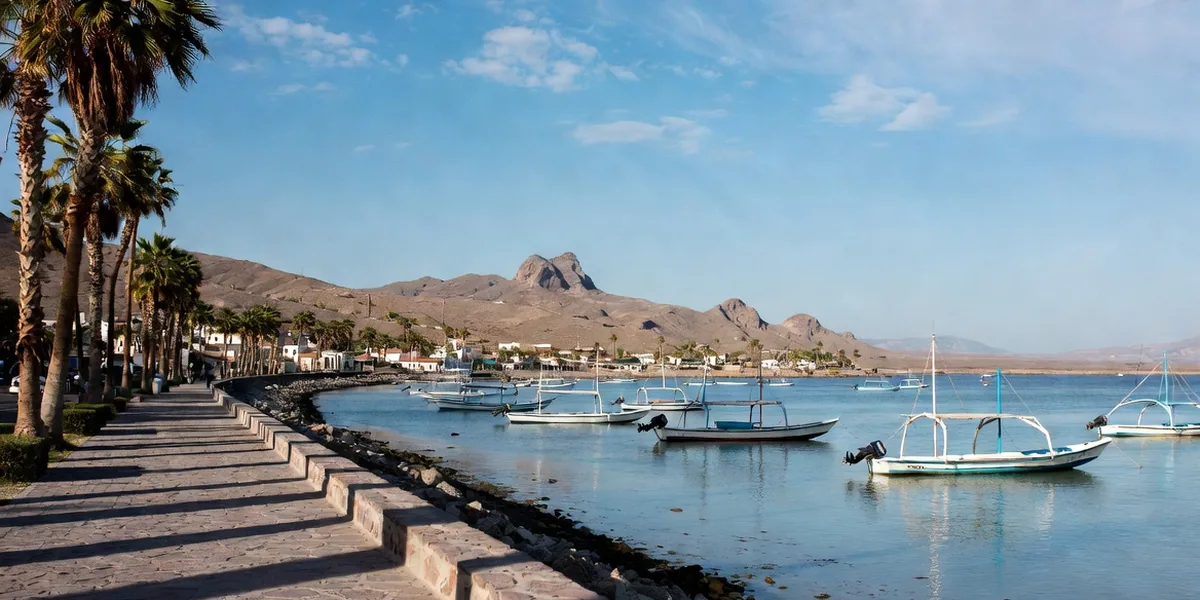
Loreto is 370 km north of La Paz on Highway 1, directly in the middle of the Baja California Sur peninsula. Most travelers on the direct flight from Los Angeles or Dallas to Los Cabos pass over it at 35,000 feet without knowing it exists. The ones who stop — drawn by the whale watching, the mission church, or a travel advisor who has actually been there — tend to become its most persistent advocates.
The town has about 20,000 residents, a compact historic center built around the 1697 mission, a malecon on the Sea of Cortez, and the Bahía de Loreto National Marine Park covering 206,000 hectares of the most biodiverse marine territory in the Sea of Cortez. No high-rise hotels. No chain restaurants of consequence. No cruise ship port. The fishing fleet and the kayaking outfitters work the same water the Jesuit missionaries crossed in the 18th century, and the whale watching boats go out before dawn to reach the feeding grounds of blue whales — the largest animals that have ever lived on Earth.
The Misión de Loreto
The Misión Nuestra Señora de Loreto Conchó was founded in October 1697 by Jesuit priest Juan María de Salvatierra and is the first permanent European settlement in the Californias — the mother of all the missions that followed up the peninsula and into Alta California. The original church structure stands on the main plaza, has been in continuous use for over 325 years, and contains one of the most significant collections of colonial religious art in Baja. The adjacent Museo de las Misiones documents the full mission chain with artifacts and maps.
The plaza in front of the mission is the social center of Loreto — benches, shade trees, and the kind of evening activity that small Mexican towns produce naturally. The historic center extends a few blocks in each direction: painted buildings, the occasional craft shop, and the sense of a place that has been continuously inhabited and cared for rather than developed around a tourism concept.
Whale Watching
The Bahía de Loreto and the surrounding waters of the central Sea of Cortez host the most diverse whale aggregation in Mexico from December through April. Blue whales — the largest animals ever to have existed on Earth, reaching 30 meters in length — feed in the channel between Loreto and Isla del Carmen. Humpbacks breach in the outer bay. Fin whales, sperm whales, and pilot whales are all reliably sighted in season. Dolphins are present year-round.
Whale watching pangas depart from the Loreto malecon pier before sunrise — the whales are most active in morning light and calm water. Tours typically run 3–4 hours and cost $60–90 USD per person. The guides are local fishermen who have been reading these waters for decades and know the feeding patterns of individual blue whales by their fluke markings. Sighting rates for blue whales specifically are near-certain from January through March.
The National Marine Park — Kayaking and Snorkeling
The Bahía de Loreto National Marine Park protects four large islands — Isla del Carmen, Isla Coronado, Isla Danzante, and Isla Monserrat — along with the channels between them. The islands are uninhabited, and the marine life in the protected waters includes sea lions, manta rays, sea turtles, whale sharks (May–October), and reef fish populations that the protection has allowed to recover significantly since the park was established in 1996.
Kayaking to Isla Coronado (8 km offshore) is the standard half-day activity — the crossing takes 1.5–2 hours in calm conditions, the sea lion colony on the island's northern tip is accessible by swimming, and the snorkeling in the cove below the colony is exceptional. Full-service kayak outfitters in Loreto provide equipment, guide, and a support boat for the crossing. The multi-day kayak camping trips through the island chain are among the best wilderness experiences available in the Sea of Cortez.
Kayak outfitters, whale watching operators, and diving in the national marine park: Los Cabos and Baja activities.
Sport Fishing
Loreto's fishing reputation centers on yellowtail (November through May), dorado (May through October), and billfish from May through November. The fishing here is less commercially developed than Los Cabos — fewer large charter operations, more local pangas, and generally lower prices for comparable access. Half-day pangas for two fishers run $150–200 USD. Full-day charters run $250–350 USD for a group of four.
The catch-and-release culture is stronger here than in the Cabo corridor — park regulations have had a measurable effect on both fish populations and fishing attitudes. Most operators release billfish automatically. The restaurants in town will cook your catch if you ask.
Getting There and Getting Around
Loreto International Airport (LTO) has direct US flights from Los Angeles (Alaska Airlines), Phoenix and Dallas (American), and Houston (United) — check current seasonal schedules as routes vary. The airport is 5 km south of the town center; taxis are the only transport option.
From La Paz: Highway 1 north for 370 km — about 4.5 hours through classic Baja desert landscape. Drive in daylight. Within Loreto, the town is small enough to walk. Rental cars are useful for reaching the beaches south of town (Playa Nopoló, Playa Juncalito) and Puerto Escondido Loreto 25 km south — a different Puerto Escondido than the famous Oaxacan one, and much quieter.
Where to Stay
Loreto has no large resort hotels and no all-inclusives. Small hotels, guesthouses, and boutique properties in the $60–150 USD/night range — all within walking distance of the mission plaza and the malecon. The Hotel Junipero on the main plaza is the historic standard; several newer boutique options exist within a few blocks. Book ahead for January through March whale season — the room inventory is small and fills during this period.
Frequently Asked Questions
Three things: whale watching (blue, humpback, and fin whales from December through April in the Bahía de Loreto), sport fishing (dorado, yellowtail, marlin), and the Misión Nuestra Señora de Loreto — the first permanent settlement in the Californias, founded in 1697, with an intact mission church that is the oldest continuously active in Baja. The surrounding Bahía de Loreto National Marine Park adds world-class kayaking and snorkeling to the list.
Loreto has its own international airport (LTO) with direct flights from Los Angeles, Phoenix, Dallas, and other US cities — Alaska Airlines and American operate seasonal direct routes. Also reachable by driving Highway 1 from La Paz (4.5 hours north) or from the border via the full Baja peninsula drive.
Yes — it is one of the most consistently recommended destinations in Baja by travelers who have been there. The national marine park, the whale watching, the mission town character, and the complete absence of resort-corridor development make it genuinely different from Los Cabos or the Riviera Maya.
Yes. Loreto is a small, relatively isolated town in Baja California Sur with a stable local community and a long history of independent tourism. It does not have the urban security concerns of some larger Mexican cities. The expat and fly-fishing community that has settled here is a consistent indicator of long-term safety.
November through April: dry season, pleasant temperatures (65–80°F), and the whale season from December through April. October and May are good shoulder months. June through September is the hottest period and most humid — the Sea of Cortez reaches 30°C and whale sharks appear offshore, but the heat is significant.
Different scale and character. Loreto is smaller, slower, and more removed from infrastructure than La Paz. The mission town atmosphere and the tighter relationship between the community and the national marine park give it a character La Paz doesn't have. La Paz has better restaurants, more accommodation options, and Espíritu Santo. For travelers who want the most off-the-beaten-track Baja experience: Loreto. For travelers who want a city plus sea: La Paz.