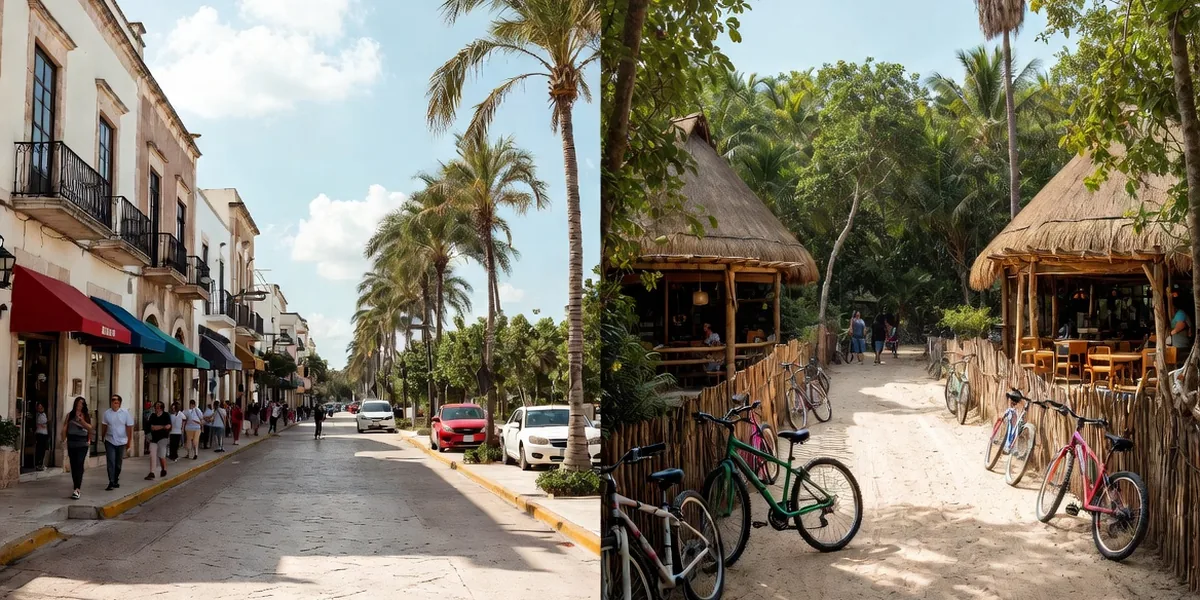
Playa del Carmen and Tulum are 65 km apart on the same stretch of Mexican Caribbean coastline. They are the two most-asked-about destinations on the Riviera Maya. They are also two completely different products. PDC is a walkable beach town with a grid, a bus terminal, and 23 blocks of pedestrian Fifth Avenue. Tulum is a Mayan ruin site, an inland town, and an 8-km coastal road of jungle-fronted beach clubs at three to four times PDC's prices. Choosing between them is mostly a question of what kind of trip you want — and how much you're willing to pay for atmosphere.
Short version: Playa del Carmen if you want a functional base with the best food and easiest logistics on the Riviera Maya. Tulum if you want the bohemian-beach-club Instagram aesthetic and you're prepared to pay for it. The smart money for most travelers: base in Playa del Carmen and day-trip to Tulum for the ruins and the southern cenotes. You get Tulum's best assets without paying for Tulum's hotel zone.
The Quick Comparison
| Factor | Playa del Carmen | Tulum |
|---|---|---|
| Beaches | Narrower; sargassum hits hard; free public access | More dramatic scenery; access mostly through hotel/club gates |
| Atmosphere | Functional beach town with a grid | Bohemian beach-club aesthetic; jungle-meets-sea |
| Food scene | Walkable, varied, consistently good | Excellent but heavily marked-up in the hotel zone |
| Walkability | High — most things within 15 min on foot | Low — town and beach are 4 km apart, hotel zone is 8 km of road |
| Hotel prices (mid-range) | $80–150/night for solid mid-range | $200–500+/night in the hotel zone |
| Restaurant prices | $15–25 per person typical | $30–60 per person in the hotel zone |
| Day trip access | Best base for Cancún, Cozumel, cenotes | Closer to Tulum ruins, southern cenotes, Sian Ka'an |
| Cenotes | 20 minutes south to Cenote Azul cluster | Immediately accessible — Gran Cenote, Dos Ojos at the door |
| Ruins | Tulum ruins are 45 minutes south | On-site — the ruins are the town's namesake |
| Sargassum risk | High May-August | High May-August (similar exposure) |
| Nightlife | Coco Bongo, Mambo Café, Fifth Avenue rooftops | Beach clubs by day; smaller curated scene at night |
| Best for | First-timers, families, multi-stop trips, budget travelers | Couples, photographers, repeat visitors, atmosphere-seekers |
Beaches — Tulum Wins for Scenery, Playa Wins for Access
Tulum's beach is the famous one. The 8-kilometer strip running south from the ruins is white sand backed by palm trees and jungle, with Mayan ruins perched on the cliffs at the north end. It is one of the most photographed coastlines in Mexico for a reason. The water is turquoise, the sand is fine, and the visual drama of the ruins overlooking the sea is genuinely unique on the Mexican Caribbean.
The catch: most of Tulum's beach is fronted by hotels and beach clubs. Public access points exist (the main one is at the end of the road from the town), but the experience the photos sell — the wide empty strip with palms and Mayan ruins — usually requires either staying at a hotel zone property or paying a beach club minimum spend ($30-80 USD depending on the venue). The beach itself is technically public per Mexican law, but getting there without going through a venue requires effort.
Playa del Carmen's beaches are narrower, more commercial, and don't have Tulum's scenic punch. But access is easier and free — every numbered street ends at the beach with a public access point. The main town beach is busy but available without paying anything. Beach clubs charge similar minimum spends to Tulum but the public alternative is genuinely walkable.
Sargassum hits both equally. May through August, both coastlines get the brown seaweed problem. Tulum's open exposure is somewhat worse on bad days; PDC's beach often gets cleaned earlier because of the higher density of beach-cleaning crews funded by clubs and hotels. Neither is reliable in summer.
Food — Playa del Carmen Wins on Variety and Value
Tulum's food scene is genuinely good. Hartwood, Arca, Rosa Negra, Casa Jaguar, and the new wave of jungle-set restaurants in the hotel zone produce serious cuisine — wood-fired, locally sourced, photogenic, and reservation-required. The atmosphere is unmatched: candlelit tables under thatched roofs in the jungle, the ocean 100 meters away. For a special-occasion dinner, Tulum hotel zone delivers an experience PDC can't match.
The catch is price. Hotel zone restaurants in Tulum routinely run $40-80 USD per person for dinner — and the wine pairings, often $60-100 USD on top, are mandatory at some venues. Mexican restaurants charging European prices because the lighting is good. Tulum town (the actual settlement inland from the beach) has more honest pricing — Burrito Amor, Antojitos La Chiapaneca, El Camello Jr — but it's a 10-minute taxi from the beach.
PDC's food is more democratic. El Fogón for the best al pastor on the Riviera Maya at $1.50 a taco. La Cueva del Chango for chilaquiles at $9. El Pirata for whole grilled fish at $20. Imprevist for omakase-level Mexican fine dining at $45 — equivalent to Tulum hotel zone meals at half the price. The variety is broader, the walkability means you can hit three places in one evening, and the price spread accommodates any budget.
The full Playa del Carmen restaurant breakdown: best restaurants in PDC.
Atmosphere — The Defining Difference
This is what most travelers are actually choosing between. Tulum is built on a specific aesthetic — bohemian beach club, candle-lit jungle, mezcal cocktails, ambient electronic music, the constant low hum of "wellness." It is a curated atmosphere that started organic in the early 2010s and has since been systematized into a globally-recognized brand. People come to Tulum specifically for this atmosphere, and Tulum delivers it relentlessly.
PDC has no atmospheric brand. It is a working beach town. Fifth Avenue is busy, sometimes loud, mostly functional — locals walking dogs, tourists eating tacos, vendors selling Cuban cigars. The vibe is closer to a Mediterranean beach town than to Tulum's curated jungle aesthetic. Some travelers find this refreshing (no posing, no $24 cocktails, real sidewalks). Others find it ordinary (no dramatic photos, no wellness retreat ambiance).
The honest read: If the atmosphere is the reason for the trip, Tulum delivers something PDC cannot replicate. If the atmosphere is incidental and you actually want to walk around a beach town, eat well, and explore the region, PDC is the more functional answer.
Tulum's hotel zone is a single 8-kilometer road with the beach on one side and jungle on the other. There is no town. There are no markets, no real grocery stores, no walkable cluster of services. Everything happens at hotels and beach clubs. The road has spotty cell service, no streetlights, and frequent traffic jams during sunset hour. Travelers expecting a "town" experience find this disorienting. Travelers who came specifically for the curated jungle-beach atmosphere find it perfect.
Day Trips — Both Are Strong, From Different Angles
Both make excellent bases for the Riviera Maya, with different strengths.
From Playa del Carmen, you can reach: Cozumel by ferry (40 min), Akumal sea turtles (20 min south), Cancún downtown (1 hr north), Cancún airport (1 hr), Tulum and the ruins (45 min south), the Cenote Azul cluster (20 min), Coba ruins (1.5 hrs), Chichén Itzá (2.5 hrs), Bacalar (3.5 hrs). The bus terminal puts every major Riviera Maya destination on a direct ADO route.
From Tulum, you can reach: The Tulum ruins (steps from the hotel zone), Gran Cenote and Dos Ojos (5-10 min), Sian Ka'an Biosphere Reserve (30 min south — completely inaccessible from PDC for a half-day trip), Coba ruins (45 min), Bacalar (3 hrs), Mérida (4 hrs). Tulum is closer to the southern cenotes and to Sian Ka'an, but further from Cozumel and Cancún.
If your priority is Cozumel, sea turtles, and Cancún access — base in PDC. If your priority is Sian Ka'an, the southern cenotes, and the ruins themselves — base in Tulum. If you want both, base in PDC and rent a car for one day to do Tulum-Sian Ka'an in a single trip.
Walkability and Logistics — PDC Wins by a Mile
Playa del Carmen has a grid. Streets are numbered (Calle 2 through Calle 38), Fifth Avenue runs parallel to the beach, and most hotels are within 5-10 minutes' walk of restaurants, the beach, and the bus terminal. You arrive by ADO bus, walk to your hotel, and never need a vehicle again. Day trips leave from a single bus terminal at the center of town.
Tulum is split between two locations 4 km apart: the inland town (where most affordable accommodation, the bus terminal, and budget restaurants are) and the hotel zone (the famous 8-km beach road with the boutique hotels and beach clubs). Getting between them requires a $5-10 taxi or a bicycle ride. Within the hotel zone itself, you need a bicycle, scooter, or vehicle to move between hotels, beach clubs, and restaurants — they're spread along the road, not clustered.
If you've never been to either, this is the difference that surprises most first-timers. Tulum looks compact in photos because the hotel zone road is the only photographed part of town. The actual town is inland and disconnected. PDC is the only Riviera Maya destination where "walking everywhere" is genuinely true.
Price — A Significant Gap
Hotels (mid-range, 4-star equivalent): PDC at $80-150 USD per night, Tulum hotel zone at $200-500+. The same property quality runs roughly 2-3x in Tulum. Tulum town (inland) is closer to PDC pricing but you sacrifice the beach-zone access.
Restaurant dinner (mid-range): PDC at $15-25 per person typical, Tulum hotel zone at $30-60 typical, fine dining $80+ before drinks.
Beach club minimums: PDC at $25-40 USD typical minimum, Tulum at $40-100 USD typical minimum.
Daily transit costs: PDC near zero (everything walkable), Tulum $15-30 USD for taxis between town/zone/restaurants.
For a 7-day trip, the difference between basing in PDC vs Tulum hotel zone runs $700-1,500 USD per person depending on hotel choice. For couples or families, that gap is real money.
Sargassum — A Wash, Both Affected
Both Tulum and Playa del Carmen sit on the section of Caribbean coast that gets significant sargassum from May through August. The brown seaweed accumulates on east-facing beaches, can pile up in significant volume, and produces a sulfurous smell when it decomposes. Some weeks during peak sargassum season, the beaches are unswimmable. Some weeks, they're clean.
Tulum's exposure is somewhat worse because the beach faces directly east into the open Caribbean. PDC faces slightly northeast and gets some protection from Cozumel sitting offshore, but in heavy sargassum years the difference is marginal. Both towns deploy beach-cleaning crews; PDC's are slightly more organized due to the higher density of beach clubs funding daily cleaning.
The workaround for both: If sargassum is a concern, time your trip for November through April. If you must travel May-August, check the Sargassum Monitoring Network's daily map before booking, and consider Holbox or Isla Mujeres as Gulf-side alternatives that don't get hit.
Both are Gulf-side islands and don't get sargassum. If your beach trip is May-August and the forecast looks bad, see the Holbox guide.
Who Should Choose Playa del Carmen
- First-timers to the Riviera Maya wanting easy logistics
- Multi-stop trips (Cancún, Cozumel, Tulum, cenotes — PDC is the best base)
- Travelers prioritizing food variety and value
- Budget-conscious travelers who don't want to compromise location
- Families wanting walkable streets and predictable infrastructure
- Anyone wanting a "real beach town" experience over a curated atmosphere
Who Should Choose Tulum
- Couples and honeymooners wanting the bohemian beach-club aesthetic
- Travelers prioritizing photogenic atmosphere over logistics
- Visitors specifically wanting the ruins, southern cenotes, and Sian Ka'an
- Repeat Riviera Maya visitors who have already done PDC and want a different vibe
- Wellness, yoga, and retreat travelers (the Tulum specialty)
- Anyone whose budget isn't a constraint and who values atmosphere as a primary good
The Smart Combined Strategy
For most travelers planning a one-week Riviera Maya trip: base in Playa del Carmen for 5-6 nights, then either day-trip to Tulum (45 minutes by ADO, $7 each way) or split with 2 nights in Tulum for the experience. This setup gives you PDC's logistics, food, and lower hotel rates as the foundation, plus a focused Tulum stay for the atmosphere — without paying Tulum hotel zone prices for an entire trip.
The one-day Tulum trip from PDC: take the 8 AM ADO bus, visit the ruins (open 8 AM, less crowded before 10), grab lunch in town at El Camello Jr or Burrito Amor, hit Gran Cenote in the afternoon, and back to PDC by evening. About $40-50 USD total including bus, ruin entry, cenote entry, and lunch. You experience Tulum's signature attractions without the hotel zone premium.
Frequently Asked Questions
Playa del Carmen, almost always. The walkability, broader food scene, easier transit, and lower prices make first-time logistics dramatically simpler. Tulum becomes more compelling for repeat visitors who already know the region and specifically want the hotel zone atmosphere.
For mid-range hotels, roughly 2-3x. For restaurants, roughly 1.5-2x. For taxis and transit, multiples more (PDC has zero internal transit cost; Tulum requires $15-30/day in vehicle costs). Over a week, the gap typically runs $700-1,500 USD per person.
Easily. They are 45 minutes apart by ADO bus. The most efficient setup is basing in PDC for 5-6 nights and either day-tripping to Tulum or splitting with 1-2 nights in Tulum. This captures Tulum's atmosphere without paying for the hotel zone all week.
Tulum has closer access to the most famous cenotes — Gran Cenote and Dos Ojos are 5-10 minutes from town. PDC requires 20-45 minutes to reach the same cluster. Both towns provide reasonable access; Tulum is the closer base if cenotes are the trip's primary focus.
Tulum has had isolated security incidents in recent years that received international media coverage but remained extremely localized — almost always linked to local commercial disputes rather than tourists being targeted. Tourist areas are well-policed. Standard precautions apply: stay in tourist areas at night, use authorized taxis, don't display valuables. PDC has equivalent risk profile and equivalent precautions.