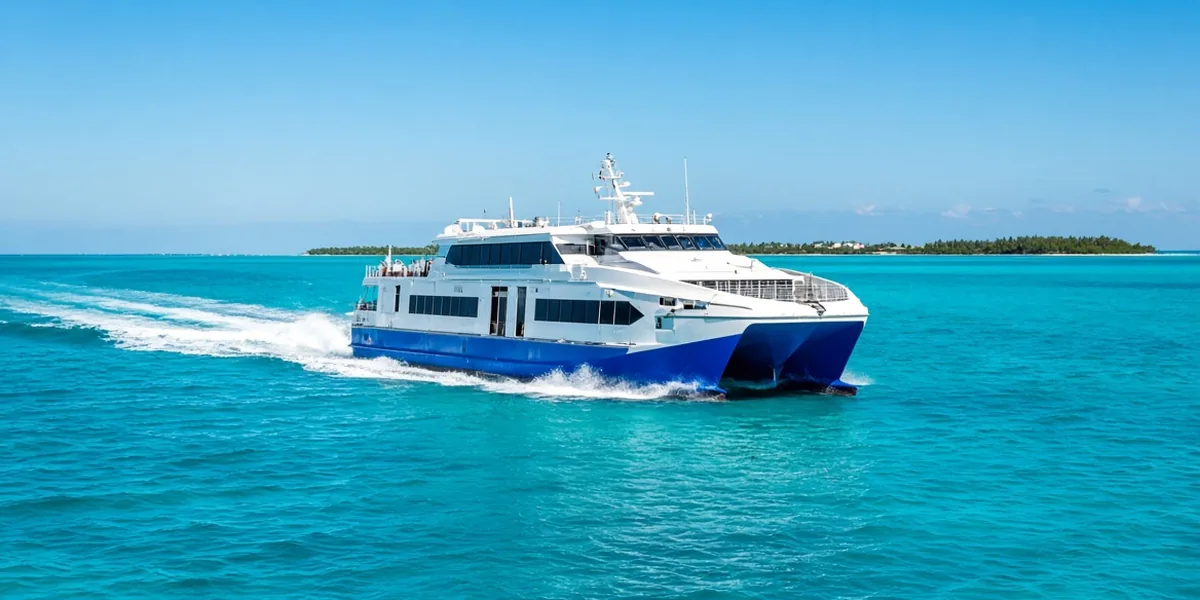
Isla Mujeres sits 13 kilometres off Cancún and the ferry is the only sensible way to reach it. It is a short, cheap, frequent crossing, and it is also the point where a lot of people accidentally spend three times what they needed to, because there are four different terminals with four different prices and the Hotel Zone ones are the most convenient and the worst value.
This is the full breakdown: every terminal, real 2026 prices, schedules, the last boat back, and the honest comparison against booking a catamaran tour instead.
Quick Facts
- Best terminal: Puerto Juárez / Gran Puerto
- Crossing time: 15–20 min from Puerto Juárez
- Round trip: ~18–22 USD adult, ~12–15 USD child
- Frequency: every 30 min, roughly 5 AM – 8:30 PM
- Last boat back: ~11:30 PM to Puerto Juárez
- Booking: not required, buy at the window
- Operators: Ultramar and Marinsa (Puerto Juárez)
The Four Terminals, Compared
Puerto Juárez / Gran Puerto — use this one
Just north of downtown Cancún, about 10 minutes from the city centre and 20 to 30 minutes from the Hotel Zone. This is the main crossing: the shortest at 15 to 20 minutes, the most frequent at every half hour, and the cheapest at around 18 to 22 USD round trip.
The terminal has parking (around 8 to 12 USD per day), a covered waiting area, and both Ultramar and Marinsa operating. Boats are large air-conditioned catamarans with an open upper deck. Getting there from the Hotel Zone costs 12 to 20 USD by taxi, or you take the R1 public bus for well under a dollar.
Playa Tortugas — convenient, pricier
Inside the Hotel Zone at kilometre 6.5. Crossing runs 25 to 35 minutes and departures are roughly every 90 minutes to two hours rather than every 30. Prices run meaningfully higher than Puerto Juárez.
Worth it only if you are staying within walking distance and the taxi to Puerto Juárez would cost more than the fare difference. The bigger issue is the sparse schedule, which restricts when you can leave the island.
Playa Caracol — the same, further up the strip
At kilometre 9 in the Hotel Zone near the Punta Cancún cluster. Same structure as Playa Tortugas: longer crossing, less frequent, more expensive. Same reasoning applies.
Punta Sam — the vehicle ferry
North of Puerto Juárez, roughly 45 minutes crossing, carries cars. There is essentially no reason for a visitor to use it. Isla Mujeres is 7 kilometres end to end, golf carts rent for 45 to 65 USD per day, and taxis on the island run 3 to 8 USD. Bringing a car creates a parking problem and solves nothing.
Hotel desks push the Playa Tortugas and Playa Caracol crossings because they are close, and they cost more while running a fraction of the departures. A taxi to Puerto Juárez is 12 to 20 USD split across your group and gives you a departure every 30 minutes plus a boat home until 11:30 PM. Where to stay in Cancún.
Schedules and the Last Boat Back
From Puerto Juárez, departures run roughly every 30 minutes from around 5:00 AM to 8:30 PM, then hourly until the last boat at approximately 11:30 PM. Returns from Isla Mujeres follow the same pattern, with the last departure from the island around 11:00 to 11:30 PM.
From the Hotel Zone terminals, the last boat back is typically between 5 PM and 7 PM depending on season. This catches people out constantly — you go over on a Hotel Zone ferry, stay for dinner and sunset, and discover the return service stopped hours ago. You then land at Puerto Juárez and pay for a taxi across the city.
Schedules shift seasonally and in bad weather. Confirm the last departure at the window when you buy, and photograph the printed timetable.
Buying Tickets
- Buy at the window. No advance booking needed outside major holidays.
- Pay in pesos. The dollar rate offered at ferry windows is consistently poor. Card payment converts at a better rate than cash dollars.
- Buy round trip. It is cheaper than two singles and the return is open — any departure, any time, same day or later.
- Keep the return stub. It is a separate ticket and losing it means buying again.
- Children under 3 travel free on most operators; ages 3 to 11 pay a reduced fare.
Ignore anyone approaching you outside the terminal offering ferry tickets, a discount, or a package. Legitimate sales happen at the counter inside.
Compare Isla Mujeres Day Trips from Cancún
Catamaran days with open bar and a reef snorkel stop, plus small-group sailing trips and golf cart packages — with live 2026 pricing.
Ferry or Catamaran Tour? The Honest Comparison
These are genuinely different products and the choice depends on what you want out of the day.
Take the ferry if:
- You want to see the island rather than the boat
- You want a full day — first ferry at 8 AM gets you Playa Norte almost empty
- You want to rent a golf cart and do the island loop to Punta Sur
- You are price-sensitive. The ferry plus a golf cart plus lunch runs around 60 USD for two people
- You want to stay for sunset and a meal
Book a catamaran if:
- The boat day is the point — sailing, open bar, music, a swim stop
- You want a reef or MUSA snorkel stop included
- You want everything handled: transport, lunch, gear
- You are in a group that wants a party structure
What catamarans do not give you is time on the island. Most allocate two to three hours, arriving mid-afternoon when Playa Norte is at its busiest. If Isla Mujeres itself is what you came for, that is the wrong shape of day. See the catamaran tour comparison for the operators worth booking, and the Cancún snorkelling guide if the reef stop is the draw.
Doing the Island as a Day Trip
- 7:30 AM: Taxi or R1 bus to Puerto Juárez
- 8:00 AM: Ferry across. Buy round trip, pay in pesos
- 8:30–11:00 AM: Playa Norte, before the tour boats arrive. This is the best window of the entire day
- 11:00 AM: Rent a golf cart (45–65 USD/day) from a shop near the ferry terminal
- 11:30 AM–1:00 PM: Drive the island loop south — the east coast road, Punta Sur, the sculpture park and the cliff viewpoint
- 1:00–2:30 PM: Lunch in centro or at one of the east coast spots
- 2:30–5:00 PM: Back to Playa Norte, or snorkel at Playa Lancheros, or the turtle farm
- 5:30 PM: Sunset on the west side, drinks on Hidalgo
- 7:00–9:00 PM: Dinner, then any ferry back
Full detail on what to do once you are there in the Isla Mujeres things to do guide, and the beach breakdown in Isla Mujeres beaches.
Isla Mujeres works far better as a base than as a day trip. Rooms run 60 to 200 USD, Playa Norte is empty before 10 AM and after 5 PM, and you can still ferry into Cancún for a specific excursion. It is often cheaper than a Hotel Zone all-inclusive. Where to stay on Isla Mujeres.
Practical Notes
- Getting to Puerto Juárez cheaply: the R1 bus runs the Hotel Zone to downtown and Puerto Juárez for well under a dollar. Slow but functional.
- Parking at Puerto Juárez: around 8 to 12 USD per day, secure, and it makes sense if you have a rental car for other Cancún day trips.
- Luggage: allowed at no extra charge on the passenger ferries; there is space at the back of the lower deck.
- Weather cancellations: rare, but north winds between November and February occasionally suspend the Hotel Zone crossings while Puerto Juárez keeps running.
- Accessibility: the Puerto Juárez terminal and the Ultramar boats are step-free; smaller operators are not.
- Seasickness: lower deck, centre, and take something 30 minutes before if you are susceptible. The crossing is short but it can be choppy.
Frequently Asked Questions
Roughly 18–22 USD round trip per adult from Puerto Juárez or Playa Tortugas, and around 12–15 USD for children. Prices are set per operator and quoted in pesos; paying in pesos is always cheaper than the dollar rate offered at the window. The Ultramar terminal at Puerto Juárez is the cheapest and most frequent option.
About 15 to 20 minutes from Puerto Juárez, which is the shortest crossing. From the Hotel Zone terminals at Playa Tortugas and Playa Caracol it runs 25 to 35 minutes. The car ferry from Punta Sam takes about 45 minutes and is only relevant if you are bringing a vehicle.
Four terminals. Puerto Juárez (Gran Puerto) just north of downtown Cancún is the main one — most frequent, cheapest, and the shortest crossing. Playa Tortugas and Playa Caracol are inside the Hotel Zone, more convenient if you are staying there but more expensive and less frequent. Punta Sam is the vehicle ferry only.
No. Departures from Puerto Juárez run every 30 minutes from roughly 5 AM to 8:30 PM and you buy at the window. Booking ahead only matters if you want a specific time slot during Christmas, New Year, or Easter week. The return is open — your round-trip ticket works on any departure.
Around 11:30 PM to Puerto Juárez, with the frequency dropping to hourly after about 9 PM. The Hotel Zone terminals stop much earlier, typically between 5 and 7 PM. If you are staying in the Hotel Zone and take a late ferry back, you land at Puerto Juárez and need a taxi. Confirm the last departure at the window on the day — schedules change seasonally.
The ferry if you want the island itself — you get the whole day on your own schedule for about 20 USD, and Playa Norte is the best swimming beach in Mexico. A catamaran tour if you want the boat day: open bar, a reef snorkel stop, lunch, and roughly three hours on the island, for 75 to 130 USD. Different products. Most people who want to see Isla Mujeres are better served by the ferry.
Yes, from Punta Sam only, and there is almost no reason to. The island is 7 kilometres long, golf carts rent for 45 to 65 USD per day, taxis are cheap, and parking is limited. The vehicle ferry exists for residents and deliveries.
Usually not. The crossing is short and the boats are large stabilised catamarans. Conditions get choppy with a north wind, mostly between November and February, and the upper open deck is the worst place to be on those days. If you are prone to motion sickness, sit on the lower deck toward the centre and take something 30 minutes before boarding.