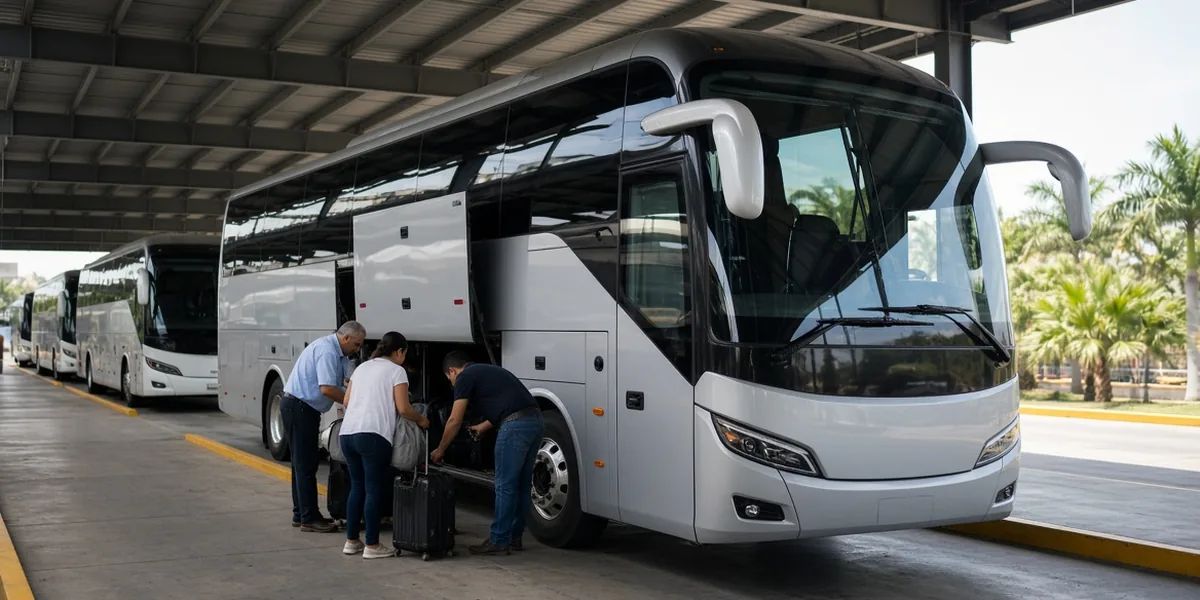
Mexico's intercity coach network is far better than most visitors expect, and ADO is the operator that runs the south and southeast. If you are travelling the Yucatán peninsula — Cancún, Playa del Carmen, Tulum, Valladolid, Mérida, Bacalar — the bus is frequently faster, cheaper, and less stressful than driving, and it is the single biggest cost saving available on a two-week trip.
This is the practical guide: what the classes actually mean, real 2026 fares on the routes people use, how the airport service works, where colectivos fit, the honest state of Uber in Quintana Roo, and when to give up and rent a car.
Fares at a Glance (2026)
- Cancún airport → Playa del Carmen: ~12–15 USD, ~60 min
- Cancún airport → downtown Cancún: ~6–10 USD, ~25 min
- Cancún → Playa del Carmen: ~8–12 USD, ~60 min
- Cancún → Tulum: ~12–20 USD, ~2.5 hrs
- Playa del Carmen → Tulum: ~6–10 USD, ~1 hr
- Cancún → Valladolid: ~15–25 USD, ~2.5 hrs
- Cancún → Mérida: ~25–40 USD, ~4–5 hrs
- Cancún → Bacalar: ~25–35 USD, ~4.5 hrs
- Tulum → Bacalar: ~15–22 USD, ~2.5 hrs
The Classes, and Which One to Book
- ADO Platino — premium. Three seats across instead of four, deep recline, extra legroom, refreshments, and usually a quieter cabin. Worth the premium on anything over four hours; unnecessary on a one-hour hop.
- ADO GL — the middle tier. More legroom than standard, generally two toilets, slightly newer fleet. The sensible upgrade on the Mérida and Bacalar runs.
- ADO — standard first class, and what most travellers use. Air conditioned, assigned seats, luggage stowed below, few or no intermediate stops. Perfectly comfortable.
- OCC and AU — second class, cheaper, older buses, more stops, sometimes no assigned seating. Fine for short daylight hops, not what you want overnight.
- Colectivos — shared vans running fixed routes, not ADO. Cheapest option on the Playa del Carmen–Tulum corridor. Covered below.
The air conditioning on all classes runs cold. This is not a small point on a five-hour journey — bring a layer, every time.
The Cancún Airport Route
ADO runs directly from all Cancún airport terminals, and it is comfortably the best value airport transfer in the region. The stop sits immediately outside arrivals at each terminal, tickets are sold at a counter and from machines, and departures run every 30 to 60 minutes.
- To Playa del Carmen: ~12–15 USD, about an hour, direct to the Fifth Avenue terminal in Centro
- To downtown Cancún: ~6–10 USD, about 25 minutes, to the ADO terminal at Tulum Avenue
- To Mérida: direct services run several times daily
The one gap: ADO does not serve the Cancún Hotel Zone. If you are staying there, you take the bus downtown then a taxi, or you book a shuttle. For a couple staying in the Hotel Zone the shuttle usually wins; for anyone heading to Playa del Carmen or Tulum, the bus wins clearly. See the Cancún airport transfer guide and the Tulum airport guide for the full comparison.
Cancún airport arrivals is one of the most aggressive sales environments in Mexican tourism. People in official-looking shirts will offer transport, upgrades, free breakfast, and rental cars. Every one of them is selling a timeshare presentation. The ADO counter and the official taxi desk are the only two things you need, and both are outside. Cancún airport transfers compared.
Booking
- Direct is cheapest. The ADO app and website sell at the lowest price. Third-party resellers add a margin.
- Advance booking cuts the fare on longer routes, sometimes by 20 to 30 percent. Short hops are flat-priced.
- Foreign cards sometimes fail on the Mexican payment gateway. If yours does, buy at the terminal counter with cash or card, which always works.
- Book ahead for: Mérida, Bacalar, Palenque, anything overnight, and everything during Christmas, Easter week, and July–August.
- Buy at the counter for: Cancún–Playa–Tulum, where departures run every 30 to 60 minutes.
- Bring ID. Names are printed on tickets and are occasionally checked.
Colectivos: The Cheaper Local Option
Colectivos are shared white vans running fixed routes with no fixed schedule — they leave when full, which on the busy corridors means every few minutes. On the Playa del Carmen to Tulum run they cost a fraction of the bus and stop anywhere along Highway 307, including at cenote turnoffs and beach access roads that ADO drives straight past.
- Playa del Carmen → Tulum: around 3–5 USD, roughly an hour, from Calle 2 Norte
- Cancún → Playa del Carmen: around 4–6 USD, from the downtown terminal area
- Tulum → Cobá and the cenote turnoffs: the main advantage — buses do not stop there
Trade-offs: no luggage hold, no assigned seat, no air conditioning guarantee, cash only, and you flag them down at the roadside. For a day trip with a day bag they are excellent. With two suitcases they are not. This is how you reach the cenotes along the 307 without a car.
Uber, Taxis, and the Quintana Roo Situation
This needs stating clearly because it derails itineraries. Uber operates normally in Puerto Vallarta, Mazatlán, Mérida, Mexico City, Guadalajara, and Monterrey. In Quintana Roo — Cancún, Playa del Carmen, Tulum — it has been the subject of sustained conflict with the taxi unions for years.
What that means in practice: the app may work, but drivers often will not collect from airports, bus terminals, or hotel entrances, and there have been documented incidents of confrontation. Availability changes. Do not plan around it.
Taxis in Quintana Roo are unmetered and the rates are set by the union. Agree the fare before getting in, in pesos, and know roughly what the route should cost. Hotel Zone to downtown Cancún runs 12 to 20 USD; within the Hotel Zone 8 to 15 USD; Playa del Carmen within Centro 3 to 6 USD. Hotel desks can call a taxi and quote the fare in advance, which removes the negotiation entirely.
Bus or Rental Car?
Take the bus for point-to-point travel between towns. Take a car for anything off the highway.
Bus wins for:
- Cancún ↔ Playa del Carmen ↔ Tulum — frequent, cheap, no parking problem
- Long hauls to Mérida, Bacalar, Campeche, Palenque
- Solo travellers and couples, where a car is expensive per head
- Anyone who does not want to deal with Mexican rental insurance upselling
Car wins for:
- Cenotes — most sit down unmarked side roads with no bus service
- Ruins beyond the main sites — Ek Balam, Muyil, the Puuc route
- Beaches off the highway — Akumal, Xpu-Ha, Paamul
- Groups of three or more, where 35–55 USD per day splits well
- Getting anywhere before the tour buses arrive
The efficient pattern on a two-week trip: bus between bases, then rent a car for two or three days in the middle for the cenote and ruins runs. You avoid paying for parking in towns where you do not need a vehicle. Toll roads are worth it — the 180D to Mérida costs around 30 USD each way and saves well over an hour versus the free road.
Rent a Car for the Off-Highway Days
Compare Cancún airport rental prices across agencies. Check what your card actually covers in Mexico before declining the counter insurance.
Compare rental cars in MexicoTerminal Notes by City
- Cancún: two relevant terminals. The main ADO terminal downtown on Avenida Tulum, and the airport stops. The Hotel Zone has neither.
- Playa del Carmen: two terminals. Terminal Turístico on Fifth Avenue at Calle 1 handles the Riviera Maya corridor and is a two-minute walk from the Cozumel ferry. Terminal Alterna on Avenida 20 handles long-distance departures. Check which one your ticket names.
- Tulum: one terminal on the main highway through the pueblo. Ten to fifteen minutes by taxi from the beach hotel zone.
- Mérida: CAME terminal for first class and above, Terminal Noreste for second class. Different buildings.
- Bacalar: a small terminal in town, walkable to most accommodation. See the Bacalar guide.
- Valladolid: central terminal, walking distance from the main square and a good base for Chichén Itzá.
Cancún airport to Playa del Carmen, Playa to Tulum, Tulum to Bacalar, Bacalar to Mérida, Mérida back to Cancún. Five legs, roughly 100 to 130 USD per person in total, no car required at any point except an optional two days for cenotes. Start with the Riviera Maya guide.
Practical Notes
- Arrive 20 to 30 minutes early at terminals. ADO departs on time and does not wait.
- Keep your luggage receipt. Hold bags are tagged and the stub is checked on collection.
- Bring a layer. The air conditioning is genuinely cold on every class.
- Toilets exist on first class and above but are basic. Longer routes make a rest stop.
- Snacks: Platino includes light refreshments; everything else does not. Terminals have shops.
- Wifi and power are advertised on GL and Platino and work inconsistently. Download offline before boarding.
- Valuables in your day bag, not the hold. Standard practice everywhere, not a Mexico-specific warning.
Frequently Asked Questions
ADO is Mexico's largest intercity coach operator and the backbone of long-distance travel across the south and southeast, including the entire Yucatán peninsula. Buses are modern, air-conditioned, assigned-seat coaches with luggage stowed underneath and a ticket-and-terminal system closer to an airline than to a local bus. It is the standard way to move between Cancún, Playa del Carmen, Tulum, Mérida, Valladolid, and Bacalar without a car.
Roughly 12–20 USD depending on class and how far in advance you book. Cancún to Playa del Carmen runs about 8–12 USD, Cancún airport to Playa del Carmen about 12–15 USD, Cancún to Mérida about 25–40 USD, and Cancún to Bacalar about 25–35 USD. Prices rise close to departure and during holiday periods.
Yes. ADO's first-class and premium services are the safest long-distance ground transport in southern Mexico — modern fleets, GPS-tracked, secure terminals with bag scanning on some routes, and drivers on regulated shifts. Standard travel sense applies: keep valuables in your day bag rather than the hold, and stick to first-class or above on overnight routes rather than second-class local services.
ADO Platino is the premium tier with wide reclining seats, three across, more legroom, and refreshments. ADO GL is a step below with extra legroom and typically two toilets. ADO is standard first class — air-conditioned, assigned seats, comfortable, and the class most travellers use. OCC and AU are lower-cost second-class services with more stops and older buses. On short hops the difference barely matters; on a five-hour run to Mérida it does.
For Cancún to Playa del Carmen or Tulum, no — departures run every 30 to 60 minutes and you buy at the terminal. For longer routes like Mérida, Bacalar, or Palenque, book a day or two ahead, and a week ahead around Christmas, Easter week, and the July–August domestic season. The ADO app and website both sell direct and are the cheapest channel.
Yes, and it is the best value airport transfer on the coast. ADO runs directly from all Cancún airport terminals to Playa del Carmen and to downtown Cancún, roughly every 30 to 60 minutes, for about 12–15 USD. The stop is immediately outside arrivals. It does not serve the Cancún Hotel Zone, which is the one gap — for that you need a taxi or shuttle from the downtown terminal.
Yes in most large cities including Mexico City, Guadalajara, Monterrey, Mérida, Puerto Vallarta, and Mazatlán. It is restricted or contested in several tourist destinations because of taxi union pressure — Cancún, Playa del Carmen, and Tulum have had ongoing conflict, and drivers frequently cannot pick up at airports, terminals, or hotel entrances even where the app works. Do not build an itinerary assuming Uber will be available in Quintana Roo.
Bus for point-to-point travel between towns — it is cheap, frequent, comfortable, and removes parking and insurance hassle. Car for cenotes, ruins, and beaches that sit off the highway, where a bus gets you to the nearest town and no further. The most efficient approach on a longer trip is bus between bases and a rental car for two or three days in the middle.