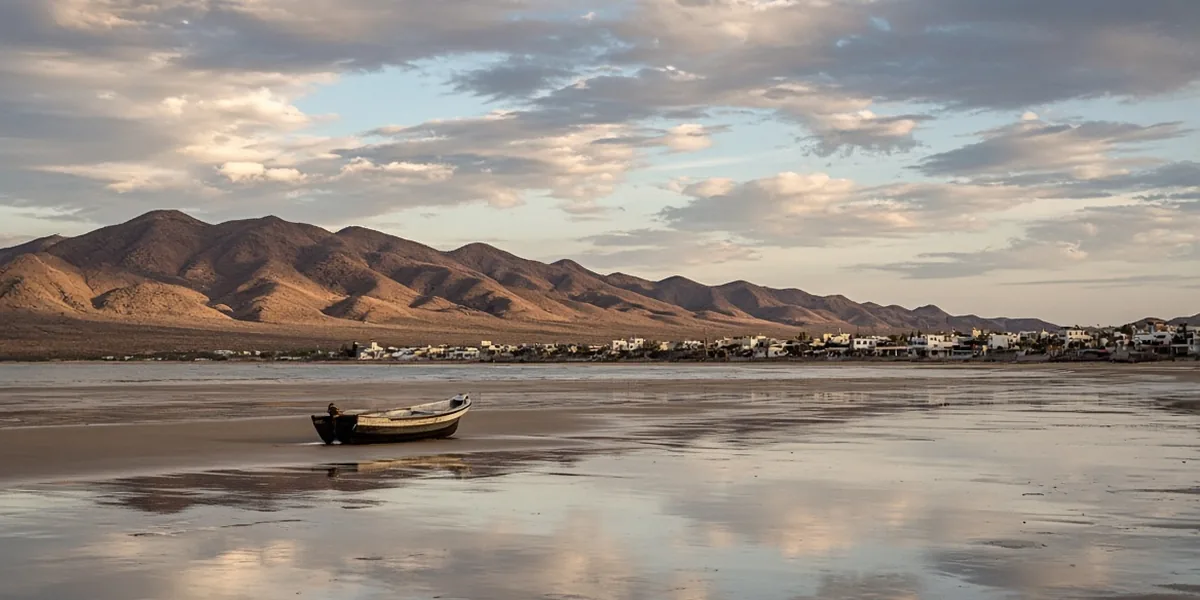
San Felipe is a small fishing town on the northern Sea of Cortez, about two and a half hours south of the Mexicali border crossing, and it occupies a specific niche: it is the closest genuine Mexican beach town to the American Southwest that you can reach without flying. For a lot of people in San Diego, Phoenix, and Yuma, that is the entire proposition.
It is not a resort destination and does not pretend to be. What it has is enormous empty beaches, some of the most extreme tides on the continent, warm calm water, very low prices, and a desert-meets-ocean landscape that looks like nowhere else in Mexico. What it lacks is depth — a handful of good restaurants, limited nightlife, and infrastructure that thins out fast once you leave the malecón.
Quick Facts
- Location: northern Sea of Cortez, Baja California
- From Mexicali: ~200 km, ~2.5 hrs on Highway 5
- From San Diego: ~4.5 hrs via Calexico/Mexicali
- Best season: October–May
- Tidal range: up to 6+ metres — the defining feature
- Water: calm, warm, no surf, no sargassum
- Best for: drivers, RV travellers, fishing, off-road, quiet
- Not for: resort holidays, nightlife, non-drivers
Getting There
Almost everyone drives, and the drive is the reason to come.
- From Mexicali: cross at Calexico, pick up Federal Highway 5 south, and run 200 km through desert and salt flats. Roughly two and a half hours on a well-maintained two-lane road. Expect one or two military checkpoints, which are routine, brief, and polite.
- From San Diego: about four and a half hours total via Calexico. The alternative through Tijuana and Ensenada is longer.
- From Phoenix or Tucson: six to eight hours via Yuma and San Luis Río Colorado, then Highway 5.
- Continuing south: Highway 5 now runs paved all the way to the junction with Highway 1 near Chapala, which makes San Felipe a viable first stop on a full Baja road trip toward La Paz and Los Cabos.
Two non-negotiables for driving into Mexico: Mexican auto insurance, because US and Canadian policies do not provide liability coverage in Mexico and driving without it is a serious problem after any incident; and daylight driving on Highway 5, where livestock, unlit vehicles, and unmarked road edges make night driving genuinely risky.
There is no commercial air service worth planning around and no bus connection that suits most visitors. If you cannot drive, this is not your destination — consider La Paz or San Carlos instead.
The Tides — The Thing Nobody Warns You About
The northern Sea of Cortez has one of the largest tidal ranges in the Americas, regularly exceeding six metres. This is the single most important fact about San Felipe and it determines how every day here works.
At low tide the water retreats several hundred metres, sometimes close to a kilometre, exposing a vast flat of rippled sand, tide pools, and stranded shells. It is genuinely spectacular and it is also not a swimming beach at that hour. Six hours later the water is back against the seawall.
- Check a tide table before planning any beach day. Local businesses post them and they are the most-consulted piece of information in town.
- Swim on the incoming tide. The water warms as it moves across sun-heated sand flats, which makes late incoming tide the best swimming of the day.
- Low tide is for walking and tide pooling, which is worth doing at least once — the exposed flats are full of life.
- Never leave a boat, kayak, or vehicle on the flats without knowing the tide schedule. People lose vehicles to this every season.
- Beachfront rental listings that show water at the door were photographed at high tide. This is not deception, it is just tides.
San Felipe sits in the Sonoran Desert on a shallow sea. July and August routinely exceed 45°C with high humidity from the water. This is heat that causes medical emergencies, not heat you push through. Visit October through May. The Sea of Cortez alternative with year-round shoulder seasons.
The Beaches
Playa El Faro and the town beach
The main beach runs directly along the malecón in town, with palapas, vendors, and easy access. It is the busiest stretch and the most convenient, and at high tide it is a perfectly good swimming beach with warm calm water and no surf at all.
South of town toward Puertecitos
The stretch south along Highway 5 is where the empty beaches are. A series of camps, small developments, and unnamed access points spread over 40 km, most with nobody on them. This is the reason to have a vehicle. Playa Percebú and the sand dune areas are the common stops.
Punta Estrella
About 20 km south, a wide beach with camping and RV areas and a long shallow entry. Popular with families and quieter than town.
Puertecitos
Around 80 km south, a tiny settlement with natural hot springs that fill tidal pools on the rocky shore. The trick is timing — the springs are scalding at low tide and cool to a usable temperature as the sea comes in. Get the timing wrong and you either cannot get in or the pools are underwater. A genuinely unusual thing to do and worth the drive.
What Else There Is to Do
- Fishing. The northern Sea of Cortez has corvina, halibut, and cabrilla. Pangas run from the beach with local captains and are cheap by any standard.
- Off-roading. San Felipe is a serious off-road town and hosts long-running desert races. Dune areas south of town are open riding, and rentals are available.
- The shrine hill. A short walk up to the Virgin of Guadalupe shrine above town, with the best view over the bay and the sand flats. Go at sunset.
- Valle de los Gigantes. A cardón cactus reserve about 20 km south with specimens over 15 metres tall, some centuries old. High-clearance vehicle recommended.
- The malecón. The waterfront strip with seafood stands, bars, and the fish market. This is the town's social centre and the fish tacos are the reason several people make the drive.
- Boating and kayaking. The water is flat calm most mornings. Tide awareness is essential for launching and returning.
Where to Stay
Accommodation is simple and inexpensive. There are no large resorts and nothing that would be called luxury.
- RV parks and camps — the largest category and the reason many people come. Beachfront sites with hookups run 20 to 45 USD per night, and the seasonal community is well established.
- Vacation rentals — beachfront houses and condos, 70 to 200 USD per night, the best option for groups. Verify the tide situation and whether the beach at that spot is swimmable at your dates.
- Small hotels — a handful in town and along the beach, 50 to 130 USD per night, basic and functional.
- Camping — legal and common on many of the southern beaches. Bring everything; services are minimal.
Book ahead for spring break, the off-road race weekends, and US holiday weekends. The rest of the year you can usually turn up.
Practical Notes
- Cash. Pesos, and plenty of them. Card acceptance is patchy outside the larger businesses and ATMs are limited. Dollars are widely accepted at a poor rate.
- Mexican auto insurance is mandatory and cheap. Buy it online before you cross or at a border-town office.
- Fuel. Fill up in Mexicali and again in San Felipe. Stations south toward Puertecitos are sparse and not always operating.
- Water. Drink bottled or purified. Standard practice throughout Mexico.
- Phone service is reliable in town and drops out quickly on the road south. Download offline maps.
- Returning to the US: border wait times at Calexico and Mexicali vary hugely. Sunday afternoons are the worst.
- Medical. Basic clinics only. Anything serious means a drive back to Mexicali.
Who San Felipe Is For
Right destination if:
- You are driving from Southern California, Arizona, or Nevada and want a beach without flying
- You have an RV or you camp
- You want empty beaches and are not looking to be entertained
- You fish or you ride off-road
- You want a very low daily cost
- You are starting a longer Baja road trip south
Wrong destination if:
- You are flying into Mexico — there is no sensible air access
- You want resorts, spas, or a range of restaurants
- You want nightlife beyond a handful of bars
- You want reliable swimming at any hour, given the tides
- You are travelling in summer
- You want the clear turquoise water of the Caribbean — this is a shallow, sediment-rich northern sea and the colour reflects that
For the same Sea of Cortez water with considerably more infrastructure, look at San Carlos in Sonora or La Paz further south in Baja, where Balandra and Espíritu Santo deliver the postcard version of this coastline. For where San Felipe sits against the rest of the country, see the best beaches in Mexico ranking.
San Felipe works best as the first stop rather than the destination. Highway 5 now runs paved to the Highway 1 junction, which puts Bahía de los Ángeles, Loreto, and La Paz on a continuous drive south. Three weeks, one car, the whole peninsula. Loreto and the middle of Baja.
Frequently Asked Questions
San Felipe sits on the northern Sea of Cortez in Baja California, about 200 km south of the Mexicali border crossing and roughly a two and a half hour drive from the US border. It is the closest genuine Mexican beach town to Southern California and Arizona that is reachable in a day's drive without flying.
Yes if you want an unpolished, inexpensive desert beach town with warm calm water and extreme tides, and you are driving down from the US. No if you want resorts, nightlife, or a wide range of restaurants. San Felipe is a small fishing and RV town with a malecón, a few good seafood spots, and enormous empty beaches. Its appeal is space and price, not infrastructure.
Drive. From Mexicali, Federal Highway 5 runs south to San Felipe in about two and a half hours on a well-maintained road with a military checkpoint or two. From San Diego it is roughly four and a half hours via Calexico/Mexicali. There is no commercial airport service worth planning around, and no useful bus connection for most visitors.
Effectively yes. The town itself is walkable but the beaches worth visiting are spread along 40 km of coast south toward Puertecitos, and there is no meaningful public transport. Most visitors drive down from the US anyway. If you drive across the border you need Mexican auto insurance, which US policies do not cover.
Extreme — among the largest tidal ranges anywhere in the Americas, regularly exceeding 6 metres. At low tide the water retreats hundreds of metres and leaves a vast flat of sand and tide pools; at high tide it returns to the seawall. This shapes everything: swimming windows, boat launches, and whether the beach outside your rental exists at a given hour. Check a tide table before planning a beach day.
It is one of the quieter parts of Baja and has a long-established community of American and Canadian seasonal residents. Standard precautions apply — drive Highway 5 in daylight, carry Mexican auto insurance, expect military checkpoints which are routine and polite, and use common sense at night as anywhere. The town's economy runs on repeat visitors, which shapes how it treats them.
October through May. The northern Sea of Cortez is a desert coast and summer temperatures regularly pass 45°C, which is genuinely dangerous rather than merely uncomfortable. Winter is mild and dry with cool nights. Spring break and the annual off-road races bring the biggest crowds; midweek in November or March is close to empty.
Beach time, fishing, off-roading in the dunes, the malecón and its seafood stands, the shrine hill above town for the view, and day trips south to Puertecitos hot springs and the Valle de los Gigantes cactus reserve. It is a low-key place. Anyone expecting a resort activity programme will be disappointed; anyone wanting an empty beach and a plate of fish tacos will not.