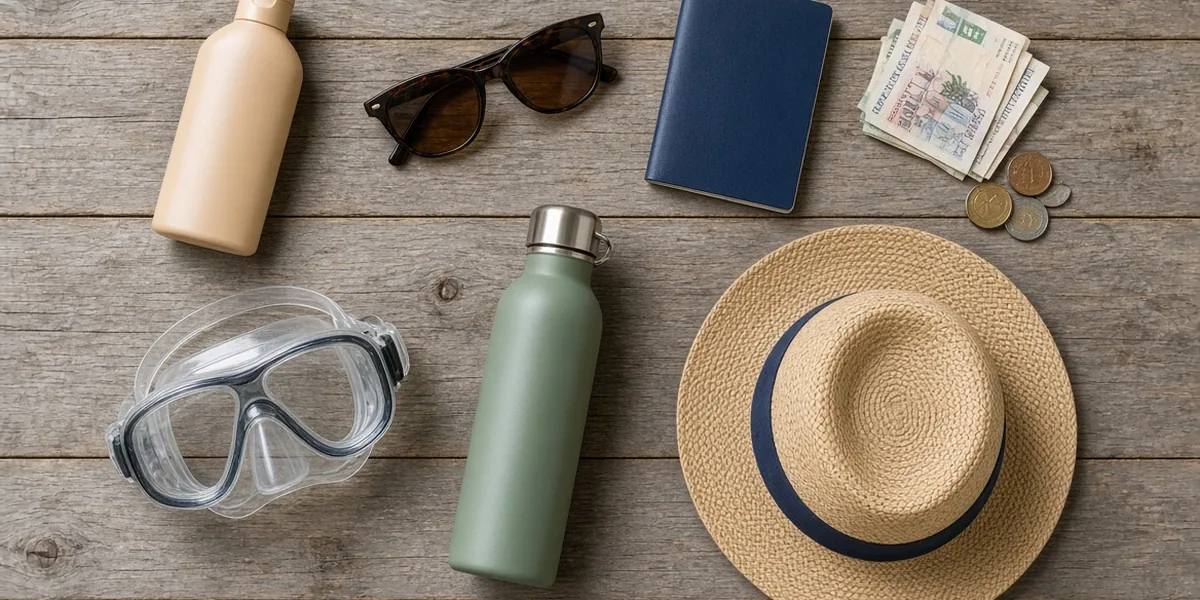
Eight practical questions come up on almost every Mexico beach trip, and the answers to most of them are simple, specific, and buried under a lot of vague advice elsewhere. This is the direct version.
Power Outlets and Plugs
Mexico uses Type A and Type B outlets — the flat two-prong and three-prong plugs used across the US and Canada — at 127 volts, 60 Hz.
- US and Canadian travellers: nothing needed. Your plugs and voltage are identical.
- UK, EU, and Australian travellers: a Type A adapter, and check voltage on every device. Laptop and phone chargers are almost always dual voltage (marked 100–240 V) and are fine with a plug adapter alone. Hair dryers, straighteners, and travel kettles are usually single voltage and will be destroyed, sometimes dramatically, by a plug adapter without a converter.
- Older buildings and small towns often have two-prong outlets only, so a three-prong grounded plug may not fit. A small multi-outlet travel strip with a two-prong plug solves this and gives you more sockets, which older hotel rooms rarely have enough of.
- Power stability is generally good in resort areas and less so in places like Holbox and Cabo Pulmo, where a power bank is genuinely useful.
Water
Do not drink the tap water, including in resorts. Mexico's treatment plants are generally fine; the distribution pipes are the problem, and this is why locals do not drink from the tap either.
- Bottled or purified only. Most hotels and rentals supply a garrafón — a large refillable jug — or a filtered dispenser.
- Ice is fine in established restaurants, bars, hotels, and resorts, where it is made from purified water. Ice from street carts in small towns is worth skipping.
- Salads and fruit in established restaurants are washed in purified water. Street food is generally fine and is one of the best parts of travelling here — the risk is overstated and comes down to picking busy stalls with high turnover.
- Brushing teeth with tap water is fine for most people. Use bottled if you have a sensitive stomach.
- Bring a filter bottle if you want to cut plastic. Refill stations are common in Sayulita, Tulum, and Puerto Escondido.
Uber, Taxis, and Getting Around
Uber works normally in Mexico City, Guadalajara, Monterrey, Mérida, Puerto Vallarta, and Mazatlán. In Quintana Roo — Cancún, Playa del Carmen, and Tulum — it has been in sustained conflict with the taxi unions for years. The app may show cars, but drivers routinely cannot collect from airports, terminals, or hotel entrances.
Taxis in tourist areas are unmetered with union-set rates. Agree the fare in pesos before getting in. Hotel front desks will call a taxi and quote the fare in advance, which removes the negotiation entirely and is the easiest approach.
For distance travel, the intercity coach network is excellent and cheap — see the ADO bus guide. For anything off the highway, a rental car is the answer, and Mexican liability insurance is mandatory rather than optional; foreign policies and most credit card coverage do not satisfy it.
Compare Rental Cars in Mexico
Check total pricing including the mandatory Mexican liability insurance before you get to the counter, where it is upsold aggressively.
Compare rental carsMoney: Pesos, Cards, and ATMs
- Pay in pesos. Businesses accepting dollars set their own rate and it is consistently 10 to 20 percent worse than the bank rate.
- Decline dynamic currency conversion. When a card terminal offers to charge in your home currency, choose pesos. The "convenience" costs you every time.
- Use bank ATMs — BBVA, Santander, Banorte, HSBC — inside or attached to a branch. Standalone ATMs in hotel lobbies and convenience stores charge high fees and poor rates.
- Withdraw larger amounts less often to reduce fixed fees.
- Carry cash for taxis, beach vendors, small restaurants, entry fees, tips, and colectivos. Cards are widely accepted in cities and rarely in small towns.
- Tell your bank you are travelling or expect a freeze on the first withdrawal.
Tipping
- Restaurants: 10–15 percent. Check whether propina is already on the bill, which is increasingly common in tourist areas.
- Bars: 20 pesos a round, or 10–15 percent on a tab.
- Tour guides: 10–15 percent of the tour price.
- Boat crews: 100–200 pesos per person on a day trip, given to the crew rather than the office.
- Hotel housekeeping: 50–100 pesos per day, left daily so it reaches the person who did the work.
- Supermarket baggers (often elderly or teenage, unpaid): 10–20 pesos.
- Parking attendants: 10–20 pesos.
- Taxis: not tipped unless they handle luggage.
- All-inclusive resorts: tipping is not required but is normal and noticeably changes service. 20–50 pesos per drink round or per bag.
At Cancún, Los Cabos, and Puerto Vallarta airports, people in official-looking uniforms will offer transport, upgrades, free breakfast, or a discounted rental car before you reach the exit. All of them are selling timeshare presentations. The official taxi desk, the ADO counter, and the rental car shuttles are outside the terminal, past all of it. Cancún airport transfers compared.
Entry Requirements and Taxes
- Passport valid for your stay; many airlines and countries advise six months' validity beyond travel.
- No visa for tourist stays for citizens of the US, Canada, UK, EU, Australia, and many others. Verify against your own government's advice, since requirements change.
- Entry permit: for most air arrivals this is now a digital record with a passport stamp rather than the paper FMM form. Note the number of days granted at immigration — it is not always the full 180.
- VisiTAX: a Quintana Roo state tax of around 15–18 USD per person, paid online, for anyone visiting Cancún, Playa del Carmen, Tulum, Cozumel, Isla Mujeres, Holbox, or Bacalar. See the VisiTAX guide, mostly to avoid the lookalike sites charging triple.
- Departure tax is included in your airfare. You do not pay it separately.
- Site and park fees at ruins, cenotes, and marine parks are usually separate from tour prices. See the excursions guide for what each adds.
Connectivity
- eSIM is the easiest option — activate before you land, works immediately, and costs less than roaming.
- Local SIM: Telcel has by far the best coverage, including in small towns and along highways. AT&T Mexico and Movistar are cheaper and patchier.
- Roaming: some US and Canadian plans include Mexico at no extra cost. Check before buying anything.
- Coverage is good in cities and resort areas, and drops fast on remote coastline — the road south of San Felipe, the Oaxaca coast between towns, and the Sian Ka'an reserve. Download offline maps.
What to Pack for a Beach Trip
Actually essential
- Reef-safe sunscreen. Required at cenotes, marine parks, and the eco-parks, checked at the water entry, and expensive to buy on site. Buy it before you go.
- Rash guard or UV shirt. Outperforms sunscreen for a full day in the water and removes the reapplication problem entirely.
- Water shoes or strapped sandals. Limestone at cenotes is sharp, rocky beach entries are common, and several eco-park circuits require them.
- A light layer. Buses, boats after dark, and evening shows are all colder than you expect.
- Insect repellent for jungle, mangrove, and canal destinations — Holbox, Sian Ka'an, Bacalar, Xoximilco.
- Refillable bottle and a small dry bag.
Commonly overpacked
- Clothes generally. Laundry costs a few dollars a load everywhere and everything dries in hours.
- Beach towels — hotels supply them.
- Full snorkel sets, unless you dive often. A mask that fits your face is worth bringing; fins and vests are supplied on every trip.
- Formal wear. Almost nowhere in a Mexican beach town requires it.
Rental masks are the single most common reason a snorkel trip disappoints — bad seals, fogged lenses, stretched straps. A mask and snorkel that fit your face cost 30 to 50 USD and pay for themselves on the first outing. Snorkeling in Cancún.
Safety, Realistically
Safety in Mexico is regional, not national, and travel advisories are issued at state level for exactly that reason. The major beach destinations — Quintana Roo, Baja California Sur, Nayarit, Yucatán, and the Oaxaca coast — are generally among the lowest-risk parts of the country, because their economies depend entirely on visitors returning.
The precautions that cover almost everything:
- Drive highways in daylight. Livestock, unlit vehicles, and unmarked road edges are the real risks, not crime.
- Agree taxi fares before getting in.
- Use ATMs inside banks, during the day.
- Do not leave belongings unattended on a beach.
- Take red and black beach flags literally. Rip currents cause far more harm to visitors on the Pacific coast than anything else. See the beach guide for which beaches are genuinely dangerous to swim at.
- Check your own government's advisory at state level before you book.
Frequently Asked Questions
Mexico uses Type A and Type B outlets — the same flat two-prong and three-prong plugs as the United States and Canada — running at 127 volts and 60 hertz. US and Canadian travellers need no adapter and no converter. Travellers from the UK, Europe, and Australia need a Type A adapter, and should check that devices accept 110–127 V; most laptop and phone chargers are dual voltage, most hair dryers and straighteners are not.
No, and this holds in resorts as well as small towns. The issue is generally the distribution pipes rather than the treatment plant. Drink bottled or purified water, and note that most hotels supply a garrafón or a filtered dispenser. Ice in established restaurants, bars, and resorts is made from purified water and is fine; ice from street carts in small towns is worth avoiding.
Yes in most large cities — Mexico City, Guadalajara, Monterrey, Mérida, Puerto Vallarta, and Mazatlán. It is restricted or actively contested in Quintana Roo, meaning Cancún, Playa del Carmen, and Tulum, because of long-running taxi union conflict. Drivers there frequently cannot collect from airports, bus terminals, or hotel entrances even when the app shows availability. Do not build a Quintana Roo itinerary assuming Uber works.
Pesos, essentially always. Businesses that accept dollars set their own exchange rate and it is consistently poor — typically 10 to 20 percent worse than the bank rate. When a card terminal offers to charge you in your home currency, decline and choose pesos; that prompt is dynamic currency conversion and it costs you money every time.
Restaurants 10 to 15 percent, and check whether propina is already added. Bartenders 20 pesos a round. Tour guides 10 to 15 percent of the tour cost. Boat crews on day trips 100 to 200 pesos per person. Hotel housekeeping 50 to 100 pesos per day, left daily rather than at checkout. Baggers at supermarkets and parking attendants 10 to 20 pesos. Taxi drivers are not tipped unless they help with luggage.
Citizens of the US, Canada, the UK, the EU, Australia, New Zealand, and many other countries do not need a visa for tourist stays. You need a passport valid for the duration of your trip, and you receive an entry permit at immigration — for most air arrivals this is now a digital record with a passport stamp rather than the old paper FMM form. Requirements change, so verify against your own government's travel advice before booking.
Safety in Mexico is highly regional rather than national, and the major beach destinations are generally among the lowest-risk parts of the country because their economies depend entirely on visitors. The practical precautions that cover almost everything: drive highways in daylight, agree taxi fares before getting in, use ATMs inside banks rather than on the street, do not leave belongings unattended on beaches, and check your own government's advisory at state level rather than country level.
Reef-safe sunscreen, which is required at marine parks and cenotes and expensive on site. A rash guard, which outperforms sunscreen for a full day in the water. Water shoes for limestone and rocky entries. A light layer for over-air-conditioned buses and evening boat rides. Insect repellent for jungle, mangrove, and canal destinations. A refillable bottle. And meaningfully less clothing than you think — laundry is cheap everywhere.