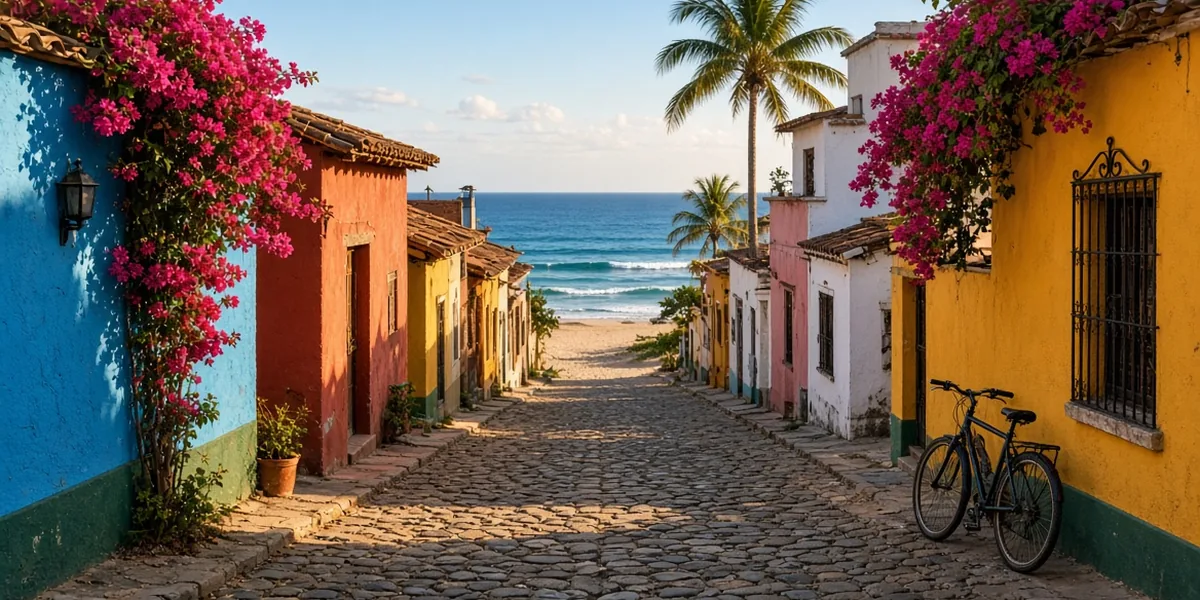
A beach and a beach town are different products, and confusing them is the most common way people end up in the wrong place. Tulum has a spectacular beach and a difficult town. Mazatlán has an ordinary beach and an excellent town. What you want depends on whether you are going to spend your week in the water or in the streets behind it.
This ranking is by what each town is actually good at, with the real downside stated. Every entry links to a full destination guide.
Best All-Round: Puerto Vallarta
The strongest combination of beach, food, walkability, and infrastructure in Mexico. The Zona Romántica is a genuinely good neighbourhood with cobblestone streets, a working beach at Los Muertos, and the best restaurant density on the Pacific coast. There is an international airport, a real hospital, and a large established foreign community.
Downside: it is a city, not a village, and the northern hotel zone is generic resort development. Stay in the Zona Romántica or Centro or you will wonder what people are talking about.
Puerto Vallarta guide · where to stay · beaches
Best Value: Mazatlán
A real Mexican city of half a million people with a restored 19th-century Centro Histórico, a 21 km malecón, and beaches that run for miles north of town. Everything costs roughly half what it does in Quintana Roo, the seafood is excellent, and the Carnaval is one of the largest in the Americas.
Downside: the beach is decent rather than remarkable, and the Zona Dorada is dated. The Centro Histórico is the reason to come.
Mazatlán guide · beaches · where to stay
Best Island: Isla Mujeres
Seven kilometres long, golf carts instead of cars, and Playa Norte — the best swimming beach in Mexico. It works as a base for the whole Cancún area while costing less and being far more pleasant than the Hotel Zone.
Downside: the day-tripper wave from 10 AM to 4 PM transforms the north end. Stay overnight or you only see the crowded version.
Isla Mujeres guide · the ferry · where to stay
Best Surf Town: Puerto Escondido
Zicatela is one of the heaviest beach breaks on the planet and the town around it has evolved into the best small-town food and nightlife scene on the Oaxaca coast. La Punta at the south end is the laid-back beginner-friendly neighbourhood; Zicatela is the serious end.
Downside: you cannot swim at the main beach, and people underestimate this constantly. Carrizalillo and Puerto Angelito are where you actually get in the water.
Puerto Escondido guide · beaches · surf guide
Best Small Beach Town: Sayulita
Cobblestone streets, a beginner surf break directly off the town beach, and a food scene disproportionate to its size. Forty-five minutes north of Puerto Vallarta airport, which makes it one of the most accessible small towns in the country.
Downside: it is the most crowded it has ever been, and prices now approach Puerto Vallarta's. San Pancho next door is what Sayulita was ten years ago.
Sayulita guide · surf · beaches nearby
Best for Doing Nothing: Holbox
Sand streets, no cars, golf carts, and a shallow turquoise sea you can wade into for a hundred metres. Whale shark season runs mid-May through mid-September and the bioluminescence appears on dark nights in summer.
Downside: mosquitoes are serious, the island floods in heavy rain, infrastructure is limited, and getting there takes a bus plus a ferry.
Holbox guide · whale shark season · where to stay
Best Water, No Ocean: Bacalar
A 60 km freshwater lagoon of stratified blues over white limestone, with living stromatolites along the shore. No waves, no salt, no sargassum. The town is small and unhurried.
Downside: it is not a beach town — shoreline access is largely through hotels and balnearios, and the lagoon is best experienced by boat.
Bacalar guide · boat tours · Bacalar vs Tulum
Best Base for Everything: Playa del Carmen
Within 90 minutes of the cenotes, Tulum, Cobá, Akumal, Cozumel, and every Xcaret-group park. Forty blocks of pedestrian Fifth Avenue, a genuinely good restaurant scene, and the ADO terminal and Cozumel ferry both in the centre.
Downside: the beach is narrow and busy, sargassum hits hard in season, and Calle 12 is unsleepable.
Playa del Carmen guide · where to stay · vs Cancún
Best Diving Town: Cozumel
Palancar, Columbia, and Santa Rosa Wall put Cozumel among the top drift-diving destinations anywhere. San Miguel is a real town with an economy beyond tourism, and the east coast is wild and largely empty.
Downside: cruise ship days transform the waterfront. Check the port schedule before booking a day trip.
Cozumel guide · diving and snorkelling · Palancar Reef
Best Sea of Cortez Town: La Paz
A working state capital on the Baja peninsula with the best malecón in Mexico, Balandra half an hour away, and Espíritu Santo offshore. Whale sharks in winter, sea lions year-round, and none of Los Cabos' pricing.
Downside: the city beaches are unremarkable — the good ones are all a drive or a boat ride away.
La Paz guide · beaches · whale watching
Best Quiet Pacific: Mazunte and San Agustinillo
Two adjoining villages on the Oaxaca coast with a slower pace than Puerto Escondido an hour north. Punta Cometa in Mazunte is the best sunset viewpoint on the Pacific coast; San Agustinillo has the calmer swimming.
Downside: minimal infrastructure, limited ATMs, and the nearest hospital is in Pochutla.
Mazunte guide · San Agustinillo · Punta Cometa
Best Protected Coastline: Huatulco
Nine bays and 36 beaches inside a national park, which is why the water is as clean as it is. Planned development kept building density low, and boat-access bays like Cacaluta and San Agustín are close to empty.
Downside: the planned-resort character means it lacks the organic town feel of Puerto Escondido or Sayulita.
Huatulco guide · Oaxaca coast hub
Book Day Trips and Tours in Any of These Towns
Boat trips, snorkelling, whale watching, and food tours across every destination on this list — compared with live 2026 pricing.
Best Luxury: Los Cabos
The highest concentration of high-end resorts, golf, and sportfishing in Mexico, split between party-oriented Cabo San Lucas and the quieter colonial San José del Cabo, with the corridor between them holding the big properties.
Downside: expensive, and much of the Pacific coastline is unswimmable due to shore break. Todos Santos an hour north is the antidote.
Los Cabos guide · beaches · vs Cancún
Best for Families: Bucerías
Twenty minutes north of Puerto Vallarta airport on Banderas Bay, with a long calm swimmable beach, a walkable town centre, and prices below Puerto Vallarta's. Quieter than Sayulita and far cheaper than Punta Mita.
Downside: limited nightlife and a small restaurant range compared with Puerto Vallarta 20 minutes south.
Bucerías guide · vs Nuevo Vallarta
Best Overlooked: Manzanillo
Two bays on the Colima coast, the sportfishing capital of Mexico, and almost no foreign visitors. La Audiencia has the calmest water and best snorkelling; Miramar has the surf. Prices reflect the lack of attention.
Downside: it is a working commercial port and the industrial areas are visible. Fewer English speakers than anywhere else on this list.
Best Beach-and-Ruins Combination: Tulum
The only Mayan site on the Caribbean coast sits directly above the beach, and the cenote density inland is the highest in Mexico. The hotel zone aesthetic is genuinely distinctive.
Downside: the most expensive beach town in Mexico relative to what you get, the beach zone requires a taxi for every meal, erosion has narrowed the beaches, and sargassum hits hard. See Playa del Carmen vs Tulum before committing.
Tulum guide · where to stay · beaches
Best Sonoran Coast: San Carlos
Sea of Cortez water with none of the Baja pricing. Cerro Tetakawi above the bay, some of the best diving in northern Mexico, and a drive-down destination from Arizona.
Downside: a small town with limited dining, and summer heat that makes May through September difficult.
San Carlos guide · beaches · safety
Best Drive-Down from the US: San Felipe
Two and a half hours from the Mexicali border, with enormous empty beaches, extreme tides, and prices that belong to a different decade.
Downside: no useful air access, minimal infrastructure, and summer heat that is genuinely dangerous.
On a two-week trip, a week in each of two towns will give you a much better sense of Mexico than five towns at three nights. Travel days on this coastline are long and the good part of any of these places starts on day three. The 25 best beaches in Mexico.
Pairings That Work
- Caribbean, 10–14 days: Playa del Carmen + Bacalar, or Isla Mujeres + Holbox
- Pacific, 10–14 days: Puerto Vallarta + Sayulita, or Puerto Escondido + Mazunte
- Baja, 10–14 days: La Paz + Todos Santos
- Value, 2 weeks: Mazatlán + Manzanillo
- Never pair: Cancún and Los Cabos on one trip — opposite ends of the country and a long, expensive internal flight. See the comparison and pick one.
Frequently Asked Questions
It depends on what you want from a town rather than from a beach. Puerto Vallarta is the best all-round beach city — walkable, excellent food, real neighbourhoods, and an airport. Sayulita and Puerto Escondido are the best small towns. Isla Mujeres is the best island. Mazatlán is the best value. Bacalar is the best if you do not need an ocean.
Mazatlán, Puerto Escondido, and Mazunte are the three cheapest with real infrastructure — roughly half the accommodation and food cost of Tulum or Los Cabos. Bahía de Kino and San Felipe are cheaper still but have very limited services. Expect a good double room for 40 to 80 USD and a full meal for 8 to 15 USD in any of them.
Isla Mujeres, Holbox, Bacalar, Sayulita, San Pancho, Huatulco, and Mérida's coastal towns all have very low incident rates and small, tightly-knit communities. Safety in Mexico is highly regional rather than national, and the beach towns in this guide are generally among the lowest-risk parts of the country. Standard precautions — daylight driving between towns, agreeing taxi fares in advance, not leaving belongings on beaches — cover almost everything.
Puerto Vallarta, Mazatlán, La Paz, Mérida, and Lake Chapala's coastal equivalents draw the largest established foreign communities, with the medical infrastructure, rental markets, and services that come with them. Puerto Escondido and Sayulita have younger and more transient communities. Cost of living and healthcare access are the two variables that matter most.
Isla Mujeres, Huatulco, Puerto Vallarta, and Bucerías. All four combine calm swimmable water, walkability, and enough infrastructure that a day does not require planning. Tulum, Zipolite, and Puerto Escondido are poor family choices for different reasons — cost, surf, and rip currents respectively.
Four to five nights in one town is the point at which it stops feeling like a stop and starts feeling like a stay. Two nights is a mistake in almost all of them — you spend one day arriving and one leaving. On a two-week trip, two towns at a week each beats five towns at three nights.